"What do you mean you've hurt 'your' knee, it's Liverpool's knee" - Bill Shankly.
Showing posts with label Hodgson. Show all posts

Tuesday, January 11, 2011

The Media Narrative In Full Swing

Source

Originally published on July 1st 2010. As much as I remain a fan of the Guardian and its football output, I continue to find Paul Hayward’s take on Liverpool as daft as any I’ve encountered. But it’s not like I’m being wise after the event:

The Media Narrative In Full Swing

Good luck to Roy Hodgson. On many levels he’ll need it.

Then again, maybe he won’t. The press seem to love him, so that’s one fewer battle he’ll face than Benítez.

Having said that, I fear that some of the press, in taking one last chance to swipe at the Spaniard, are doing Hodgson no favours; in a quite comical piece, Paul Hayward of the Guardian seems to not actually understand what the former Fulham manager is all about.

By building him up into something he’s not, he’s providing false hopes. He’s putting unfair pressure on the new Liverpool boss.

First, the Guardian man’s digs about the old one.

“By the end of the Rafael Benítez reign one of the game’s great clubs had adopted a kind of mechanical pragmatism designed to destroy the opposition’s plans rather than impose their own.”

“Anfield’s regulars were suffering but were too loyal to complain. They filed out through the Shankly Gates bored. It was inimical to Liverpool’s followers to see their heroes win games by calculation alone. They revered Benítez for the 2005 Champions League win in Istanbul but could recognise the creeping joylessness of his football and his apparent inability to derive any pleasure from a goal.”

Yes, we must have managers who dance and sing after scoring. This is what the fans want. (Of course, no fuss was made when Rafa gestured and looked happy after a goal against Blackburn. Many top managers know that if you smile one minute, someone will try and wipe it off your face a minute later. Or say that you’re a disrespectful so-and-so, as they cry foul to the press five days later.)

As for the joylessness of the football, that was certainly true to some degree last season. But it was mostly away from Anfield where the lack of goals was indeed a problem; by contrast, only three teams scored more goals at home than Liverpool managed at Anfield. There were dull games there too, but people seem to think all 19 home games are always a breeze.

And while 2005 is mentioned as if it’s the only thing Benítez did right, it’s worth remembering that just over a year ago Liverpool fans had been given their closest run at a league title in 18 years, and were the Premier League’s top scorers.

I don’t think 86 points were racked up by “calculation alone”, and it’s ludicrous to suggest that was the case. Benítez’s team, shorn of Torres for large chunks, outscored a United side containing Ronaldo, Tevez and Rooney.

“Hodgson’s Liverpool will get back on the front foot. They will assert their pedigree. Nullifying the opposition will not be their religion. This is the first step out of the darkness for a side who finished seventh in the Premier League and now face a second Europa League campaign.”

This is perhaps my main problem with the piece.

Because if there’s one thing Hodgson is not it’s an ‘attacking’ coach. His Fulham side have done brilliantly these past two seasons. However, both times they scored just 39 goals.

Now, you cannot expect a side like that to be scoring hundreds of goals. But given that Fulham’s average league position over those two seasons is 9.5 (7th and then 12th), you’d expect them to rank at a similar level if they were a perfectly balanced side, or higher if they were an attacking side.

Instead, both times they ranked as the 13th-top scorers. Making for an average of … 13. In both seasons, relegated sides actually scored more goals than Fulham, including Burnley.

Now, that’s not Hodgson’s problem; he did his job well. But the love of God, let’s not make out that his success there was achieved by brushing all-comers aside, at home and in Europe, and that, by contrast, Benítez only specialised in dour football. To me, it’s a bit like praising the raisin for being a dried fruit, while at the same time criticising the currant.

At Inter Milan it was slightly better, but they were the 4th-top scorers when finishing 3rd, and joint-6th top-scorers when finishing 7th. This was no team on the front foot; not least given the number of games they drew. Again, Roy did pretty well there. He did not, however, employ ‘total football’.

At Blackburn, with an expensive squad, the goalscoring stats were unremarkable. Again, I’m not saying that in itself is failure; just that I can see precious little to back up Hawyard’s confidence of front-foot football.

There have been high-scoring games for Hodgson, but then again, Liverpool share the record for the most Champions League goals in a single game (8); put four past Madrid, Chelsea, Arsenal and Man United; and as previously mentioned, were the Premier League’s top scorers the season before last … and still the Haywards of the world paint Benítez as ultra-negative.

“High on Hodgson’s to-do list will be a purge of all the obscure shadow men brought in by Benítez during a carnival of talent speculation. Clearing out the no-names and nearly men is a vital task which Hodgson has performed already at Fulham.” [Edit: Hodgson left a team whose average age was 30. Not exactly overhauling a squad, is it?]

There is some deadwood at Anfield, although Benítez himself had already begun shipping some of it out. There are plenty of cheap players on cheap wages who will be surplus to requirements, and one or two well-paid and costly ones.

Presumably though, there is some left at Craven Cottage too: £10m on Andrew Johnson anyone? I don’t know enough about them to comment, but there are plenty of unfamiliar names in their squad, outside of the core of Fulham’s impressive side.

Worryingly, in his 1.3 seasons at Blackburn, Hodgson spent £75m (today’s money, TPI) on pretty much nothing but deadwood. And his Fulham signings have been far from perfect, too: some gems, some dross.

But as I always argued in Benítez’s defence, all managers sign loads of players who end up on the periphery, and their fare share of expensive flops; it just depends if you want to highlight them.

“This will lighten the wage bill, provide money for acquisitions and offer chinks of light to a marginalised academy, the finishing school for Michael Owen, Robbie Fowler, Steve McManaman, Jamie Carragher and Gerrard.”

Marginalised academy? Really? Or one in the middle of being overhauled to finally produce a player worthy of a regular spot? Have Liverpool let a load of top-class locals go in the past six years? (Ten years, even.) Who attracted the two famed Barcelona youth experts to Anfield last season?

In 2009-10 only 9 appearances (all by Smalling) were made by a Fulham player brought through their youth system (Liverpool had 72 by comparison, although that of course includes Carragher and Gerrard). In 2008-09, not a single appearance was made at Fulham by a trainee (Liverpool had 69). Every single appearance was by a player who had been brought in from outside.

Again, if Roy thought that was for the best, then that was for the best. But he hardly has any kind of record in giving youth a chance.

Indeed, out of the 49 managers to have at least two full Premier League seasons under their belt, the average age of Hodgson’s teams – 27.65 – is the 5th highest. By contrast, Rafa Benítez ranks 30th – at 26.22, a full year-and-a-half younger – and this is below the averages of both Alex Ferguson and Arsene Wenger.

“Hangeland’s arrival from Norway displayed Hodgson’s eye for an undiscovered talent: a virtue to be appreciated at a club £350m in debt.”

A great bit of business. Top work.

But only one example. Will a club £350m in debt appreciate a manager who’s most expensive signing at Blackburn was £7.5m Kevin Davies (£17m in 2010 money, TPI) – a horrible flop – and whose most expensive signing at Fulham was £10m Andrew Johnson?

I don’t mean to look like I’m attacking Hodgson; I’m not. I’m just doing something really crazy, called research.

And hell, trying to set the record straight at the start, so Liverpool fans don’t turn around a few months later and say “I thought this guy was supposed to be a youth-chance-giving-up-and-at-’em-attacking-general?”

Hodgson has a lot of strengths – he spoke with great authority at his unveiling today – and hopefully we will see them all come to the fore. And he may change some of his approach, and surprise us in certain areas. For him this is a new team, a new club, and he has the chance to shape it.

But to date, he is not known for attacking football; his record in the transfer market is not special; and he has no track record in blooding young players. Anyone thinking differently, based on his record to date, is most likely setting themselves up for a fall.

Thursday, December 2, 2010

Tactics: Liverpool’s new-look old-fashioned defence

Liverpool’s new-look old-fashioned defence

November 17, 2010
By Joshua Askew

In 1973, Liverpool exited the European Cup to Miljan Miljanic’s Red Star Belgrade. Having lost the away leg just 2-1, Bill Shankly had every reason to be optimistic about progressing to the quarter-finals, but an impressive counter-attacking game by the Yugoslavians ensured they went through. It was time for introspection.

Upon emergence from the famous bootroom, Shankly declared: “The Europeans showed that building from the back is the only way to play.”

“We realised it was no use winning the ball if you finished up on your backside,” said Bob Paisley. “The top Europeans showed us how to break out of defence effectively. The pace of their movement was dictated by their first pass. We had to learn how to be patient like that and think about the next two or three moves when we had the ball.”

If the Merseyside club wanted to dominate Europe as they had done domestically, they would have to develop their defence beyond the old-fashioned stoppers that had previously so impressed in their backline. Once Larry Lloyd tore his hamstring, midfielder Phil Thompson was moved back to accompany Emlyn Hughes in the centre of defence, leading to greater fluidity. “The main aim is that everyone can control a ball and do the basic things in football,” said Shankly. “At the back you’re looking for someone who can control the ball instantly and give a forward pass. It gives them more space and time to breathe. ”

At the end of the season, Bob Paisley, whose espousal of pass-and-move football was arguably greater even than Shankly’s, replaced the Scot and carried on in this direction. In came Alan Hansen, whose humble claims that he barely ever crossed the halfway line are far from true – a cultured centre-back not too different from some of the best Italian liberi, the Scot was the paradigm of what Liverpool wanted. Even his lesser defensive partner Mark Lawrenson was at odds with the typical British defenders of the time; an enduring memory of Lawrenson is his goal in the 1982 Merseyside derby, where he finished off a move he started.

“At Liverpool we don’t have anyone running into no man’s land,” explained Shankly. “If you get the ball in the Liverpool team, you want choices… you want at least two people to pass to, maybe three, maybe more… You might not be getting very far, but the pattern is changing. Finally, somebody will sneak in.”

Under Roy Hodgson, Liverpool are playing the stereotypical English kick-and-rush style that the club opposed in the seventies, only minus the rush. There is no “running into no man’s land” because no one is allowed that far forward, all there is are repeated long balls into no man’s land. Fernando Torres is out of form because the only service or support he receives are Jamie Carragher’s hoofs delivered directly to the opposition’s defenders instead of him.

Not that Hodgson is the first to do so, Gerard Houllier implemented a similar system at Liverpool to moderate success, the difference being that he actually had the players available to do so. His teams set up in much the same way as Hodgson with two narrow bands of four, forcing the opposition to play through them; it was negative but it worked. The key was the big man-quick man striking duo of Emile Heskey and Michael Owen – sit deep and you allowed Heskey closer to goal, perfect for his aerial ability, play high and you allowed Owen space in behind.

When Rafael Benitez arrived at Liverpool, he went about completely switching the way Liverpool played. Sami Hyypia and Stephane Henchoz were a dominant partnership under Houllier, but were ill-suited to Benitez’s style. Their reading of the game and domineering physique were key when playing Houllier’s backs-against-the-wall style, but their lack of pace would be exposed by the higher line Benitez required to play his more imposing style. Henchoz was immediately dropped for Jamie Carragher while Hyppia was later replaced by Daniel Agger and Martin Skrtel.

Prior to Benitez’s arrival, Carragher was considered as part of the deadwood alongside the likes of El Hadji Diouf and Salif Diao that needed removing – however his reinvention as a centre-back proved to be a masterstroke. Given videos of Sacchi’s Milan and his training under his new manager, his reading of the game improved tenfold and, while he’s never been anything close to quick, he had the extra yard of pace necessary to make those last ditch tackles. Previously, he was the equivalent of John O’Shea to Liverpool – a utility player to fill in any gaps in the defence. As a right-back, he had frustrated Liverpool fans with his complete lack of attacking ability and, with the success of Arsene Wenger’s use of attacking full-backs at Arsenal, was replaced by Steve Finnan.

A huge fan of Arrigo Sacchi, Benitez aimed to apply the idea of universality to his team as well as the pressing, carrying on where Houllier had begun and what Shankly and Paisley had done years before. When Finnan began to age, in came Alvaro Arbeloa, a solid if fairly unspectacular player, but one whose attacking qualities are generally underrated, and then Glen Johnson, a right-back so attacking that his weaknesses lie in his defensive game.

At left-back was Djimi Traore until John Arne Riise was moved back from his left-midfield position, and once he was (mistakenly) sold on, Fabio Aurelio and Andrea Dossena vied for the position; the first a former central midfielder with an exquisite left foot and the latter a bombing wing-back. Eventually, it was the young Emiliano Insua who became first-choice – another full-back whose defensive qualities were called into question more often than his attacking ones.

In the centre came Daniel Agger and Martin Skrtel – both very good ball-playing defenders, particularly Agger, who is reminiscent of Hansen, and notably faster than their predecessors making them better suited to Benitez’s higher pressing. Behind them is Pepe Reina, one of the finest sweeper-keepers around and perfect for dealing with any balls played over the top. It is fair to assume that the backline Benitez was hoping to create was one of Reina, Insua, Agger, Skrtel and Johnson had he continued.

Fast forward to Hodgson’s tenure and against Stoke Liverpool had a much deeper backline of Reina, Paul Konchesky, Skrtel, Sotirios Kyrgiakos and Carragher. Reina, I repeat – one of the finest sweeper keepers around, is being groomed for a more English style. Konchesky has most of his question marks over his defensive ability too, but only because we knew he had nothing going for him on an attacking front. Skrtel looks nervous all the time playing in such a deep defence, wary of how close to goal he is. Kyrgiakos is a player on form because he reads the game well and is physically imposing, much like Hyypia and Henchoz, but isn’t particularly good with the ball at his feet.

Meanwhile, Carragher, his extra yard of pace gone, is playing at right-back again, endlessly hoofing the ball forward instead of passing the ball a few yards to Lucas, whose red card was most likely born out of frustration that he was endlessly having to retrieve the ball because Carragher was electing to give it away with his embarrassingly poor long balls rather than pass it to him (Lucas made just 25 passes on Saturday, almost half as many as in the same fixture last season – a game that Benitez was particularly defensive in without any fit wingers – with Stoke having more than 50% of possession for the first time since they have been promoted to the Premier League). The likes of Agger, Johnson, Martin Kelly, Danny Wilson, Daniel Ayala and Andre Wisdom must be wondering what they have to do to displace someone who’s looked like the average player he always was without Benitez for the past 18 months, especially since he’s been rewarded with a new two year contract – let alone Insua, who’s been replaced by the worst player I can recall playing for Liverpool.

Gareth Roberts recently put forward the suggestion that Hodgson hasn’t improved a single thing since taking over, but it goes further than that: tactically, Benitez has him beat, Houllier has him beat, as do Roy Evans, Kenny Dalglish, Paisley and Shankly. If a man who’s been dead for close to thirty years and famously couldn’t complete a week-long coaching course because he found it too boring tactically outmaneuvering Hodgson isn’t a sign that he should receive his P45, I don’t know what is.

Saturday, October 9, 2010

The new, submissive Liverpool FC under Roy Hodgson

Source


There has been an ever-increasing amount of hot air and bluster surrounding Liverpool Football Club these past few years. The club has been a well-documented mess behind the scenes under the stewardship of Tom Hicks and George Gillett, with fans veering between despair and fury from moment-to-moment. But with the dark days of Hicks-Gillett apparently about to end, full focus can return to matters on the pitch.

The purpose of this piece is to attempt to present a rational analysis of what has been happening on the pitch so far this season, and how the tactical approach during the nascent Roy Hodgson era contrasts to Rafael Benitez’s side. Of course, the use of the word ‘nascent’ is pertinent as it is very early into the new manager’s reign, but early tactical trends displayed are consistent with Hodgson’s M.O. Moreover, Hodgson might not last long enough at the helm to warrant long term analysis.

Off The Ball

Earlier this season Andy Gray remarked that Liverpool’s set-up under Hodgson thus far was not too dissimilar to Benitez’s approach - two holding midfielders, with an advanced midfielder behind a single forward. In a crosses marked on a blackboard approach to presenting formations, this is correct. However, herein lies the danger of reducing formations to a series of numbers and dashes, whether it be 4-4-2, 4-2-3-1, 4-3-3, and so on. Two teams featuring the same names placed into the same framework can still be markedly different from one another in practice.

Both Benitez and Hodgson generally set up their sides in variations on 4-2-3-1/4-4-2/4-4-1-1, but there are key distinctions to be made. The biggest difference between the two managers’ approaches is in how they set up their team off the ball.

Now, at this point I feel it worth noting that I agree with the broad assertion that both managers are defensive-minded by nature. (Although I’d also like to note that Andy Gray’s assertion before the Manchester City match that Roy Hodgson was about to “let the reds off the leash” by fielding two strikers in that game was laughable. However, the “two strikers = more attacking” debate is one for another day.) Yet there is more than one way to stop the opposition, and the two managers are quite different on that front.

During these early days Hodgson’s Liverpool have set up with a compact defensive line that has never strayed too far away from the 18 yard line, with a compact midfield four not too far ahead. Then, one of Fernando Torres or David Ngog has led the line, with a revolving list of second strikers supporting. One thing that has been notable in these early days is the large gap between the team’s striking spearhead and everybody else on the pitch, though this is something I will return to later on.

When off the ball, Hodgson’s side retreats deep into its own half and forms a narrow double barrier of midfield and defence in front of the opposition. Possession is ceded, and the onus is placed upon the opposition to penetrate these two static lines. One thing Hodgson’s sides do not tend to engage in is pressing the opposition, as Danny Murphy’s quotes comparing the approaches of Hodgson and new Fulham boss Mark Hughes reveal:

“Off the ball [under Hughes] maybe we’re trying to win it a bit higher up the pitch, maybe take a few more risks. With Roy we tended to drop off more and fill in the gaps.”

The rationale for this kind of approach is simple: when you do it well, and your side maintains its shape, it can be incredibly difficult for opposition teams to break you down. Teams cannot get in behind your defence through the centre with a ball played over the top, it requires great passing, movement and technique to play through your defence on the ground, and - providing you have defenders who are strong in the air - you’re well equipped to deal with crosses from teams that will attack you from out wide.

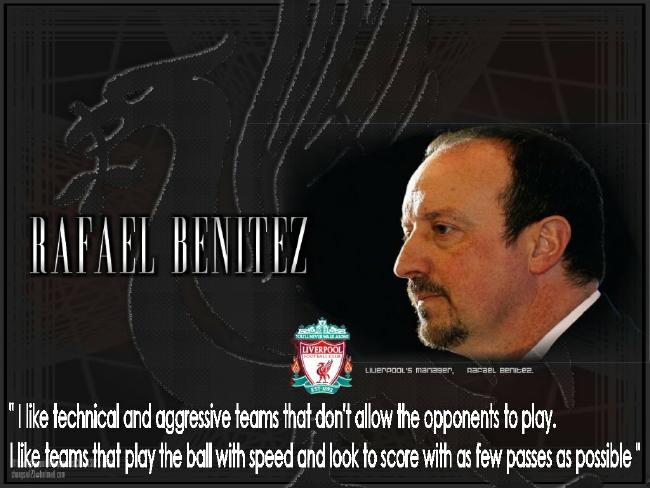
Comparatively, while similarly concerned with stopping the opposition as a first priority, Benitez’s Liverpool had a tendency to press teams aggressively as a means of preventing the opposition from playing through them. Greatly influenced by Arrigo Sacchi’s AC Milan side, Benitez liked his team - remaining compact in terms of the distance between defence, midfield and attack - to squeeze up against their opponents while out of possession. For every negative pass played by the opposition, the team was to push forward as one block, with the relatively positioned player systematically closing down the man in possession.

However, this wasn’t exclusively the team’s way of working off the ball, with Benitez - like Sacchi - prizing adaptability and game intelligence above all other characteristics. Thereby there would be situations where the team would retreat into a half-press, limited to their own half, with the pressing forwards and midfielders withdrawing again when the ball was played back into the opposition’s half. This would usually be utilised when already leading a match, with the aim of conserving energy and drawing the opposition forward in order to counter-attack quickly. Similarly, the team could also retreat deep in a style similar to Hodgson’s side when circumstances dictated and the team was under pressure. Another method of defending more readily used by Benitez’s side when possible was by maintaining possession for long periods, though this approach was hindered when the side lost Xabi Alonso.

But what is clear is that more so than Hodgson, Benitez tended to mix up the team’s approach to defending, depending on the opposition’s characteristics or in-game circumstances.

The Turnover and Problems Faced

One area of similarity between both managers, though, is the use of the counter as a primary mode of attack in open play. It is in the moments after the turnover of possession when their sides will seek to exploit the opposition’s vulnerability.

For Benitez, this approach was most memorably effective in high-profile Champions League home games against the likes of Real Madrid (2009) and Juventus (2005). Against high profile, technically proficient (and arguably stronger, at least on paper) teams, Liverpool pressed hard and high up the pitch, challenging aggressively for any second balls, with the attacking midfielders quickly supporting the line-leading striker. Opponents that were used to easily dominating possession in matches were rushed into giving the ball away in dangerous areas.

The key here for Benitez’s side was in the fact that the turnover of possession was happening in close proximity to the opposition’s goal, increasing the likelihood of creating goalscoring opportunities. Liverpool were able to exploit the disorganisation their high pressing caused defensively as opposition players were found off-guard and out-of-position.

Of course, these are very famous individual examples, reflecting some of Benitez’s greatest successes. However, that is not to say that Liverpool under Benitez could generally be regarded of proponents of swashbuckling, aggressive football. There were many occasions when Liverpool struggled and were poor when in possession, despite being excellent at recovering it. Moreover, the side had real problems in creatively overcoming lesser opponents.

It was against those sides that would readily cede possession to Liverpool and sit back that Benitez’s side mostly struggled. When playing against ‘superior’ opposition and taking the role of underdog, the team could use the pressing and counter-attacking approach to good effect. Against sides that would ‘park the bus’, the team - not always blessed with great, creative or pacey individuals - would struggle to make attacking inroads. More often than not their superiority would tell, but in cases where they couldn’t score the goal that would draw opponents out of their deep, defensive shape, Liverpool would find themselves drawing matches they would be expected to win - sometimes even losing to a sucker-punch goal or two.

Hodgson’s side, by contrast, are set up in much the same way as the opponents that have so frustrated Liverpool for many years. With a deep defensive line and a lack of pressure on the ball, the side must rely on a more direct approach or set pieces when looking to attack the opposition’s goal. Whereas before, when Pepe Reina would pick up a loose ball from an opposition attack, the team would quickly push forward, with two players taking up advanced wide positions on either side for a quickly distributed kick or throw. Now, the team seems stuck in its deep, compact shape - with the wide players tucked in, and Fernando Torres often the lone central target for any kind of direct distribution.

This role - that of a hold-up target man - doesn’t especially suit Torres. While he is capable of holding the ball up, he is at his best when facing the opposition’s goal. This goes without saying how 3 years of solid football appears to have sapped his physical power. Indeed, in the summer Hodgson spoke of seeking to buy a striker “of a certain profile”. The fact that Liverpool were so heavily linked to the likes of Carlton Cole and Mario Gomez suggests that Hodgson wanted a more powerful target man type - someone who could play with his back to goal and hold the ball up, while the deeper, narrower midfield caught up with the play.

This was how Fulham operated under Hodgson, with Bobby Zamora able to receive long balls upfield with his back to goal and hold the ball up. Daniel Agger was allegedly quoted recently as saying that Hodgson likes to “play football in attack, but not at the back”. Though possibly misquoted or set up by the Danish press, the intimation is that defenders are to recover possession and get the ball forward quickly and directly, from where moves can be built. If this is indeed the case, it would lend weight to the idea that Hodgson requires a target man, as well as offering some understanding to Liverpool’s attacking problems this year.

Regression

Further problems to be found with this approach continue to reveal themselves with every stuttering, disjointed Liverpool performance. Roy Hodgson inherited a team that was very good at recovering possession quickly - never allowing opponents to find any rhythm - but sometimes poor when faced with teams that wouldn’t play into their counter-attacking strengths. Hodgson’s tactics have taken away the team’s greatest strength, and compounded their greatest weakness.

In the second game of the season against Manchester City, it was quite astonishing to see a Liverpool side allow its opponents free rein in midfield. By offering no pressure while out of possession the team looked all-at-sea defensively, and for the first time in a long time we saw a Liverpool side passively allow the other side as much time and space as they liked in the first two thirds of the field. Daniel Agger, makeshift and concussed at left-back, was repeatedly embarrassed by Adam Johnson. Yaya Toure, Gareth Barry and Nigel De Jong bypassed Lucas and Steven Gerrard at will in midfield. It was the worst performance by a Liverpool team off the ball I have seen in five or six years (though there have been many bad ones on the ball in that time).

And with the shift to a deeper defensive line and narrower team set-up, Liverpool’s problems in attack have been made even worse. Much has been made of Fernando Torres’ problems with form and fitness, and those points are very valid. But arguments against Torres’ attitude and body language must take into account how isolated he has become from his team mates. Torres is now only receiving high, difficult balls, playing almost exclusively with his back to goal and being expected to attack teams on his own when he is - as mentioned - half fit and out-of-form.

One of the players bought to help Liverpool overcome their attacking deficiencies, Glen Johnson, is looking more confused and drained of confidence by the game. Johnson is never likely to win any plaudits as a great defender, but last season he was one of Liverpool’s strongest attacking outlets. Playing in a deeper, more rigid team he appears unsure of whether he should move forward or stay back, attack wide or move centrally. Prior to this season Johnson was occasionally liable to attack through the centre of the field to good effect, knowing that someone would move into a position on the right in order to offer an outlet out wide. Now, with Liverpool’s wide players remaining tucked inside (unsurprising, when central-midfielder Raul Meireles is used as a right-midfielder), Johnson’s occasional central forays are only serving to congest and narrow the play.

Outcomes

As stated at the beginning of this article, there remains some question over whether Roy Hodgson will be allowed to remain in his position if results and performances continue to slide. Fan unrest - unusually for Liverpool fans - is quickening. Many are still upset at Benitez’s departure. But regardless, with Liverpool currently in the relegation places and the ownership situation appearing to be drawing to a close, scrutiny of the team’s - and manager’s - performances will only increase from here.

Many have argued that Hodgson needs time and financial backing in order to get the team performing again. Many have argued that he is only picking up the pieces of Benitez’s supposedly failed reign. But the fact remains that Hodgson has inherited a team that - by and large - has been expected and used to being the dominant side in matches. Benitez’s greatest feats were in those games when his side weren’t expected to be dominant, instilling a belief that the team could beat any opponent through intelligence, adaptability and unity. However, Hodgson is now setting up the team to approach every game as the underdogs, no matter the opposition - attempting to ‘park the bus’ in front of teams that would expect to ‘park the bus’ themselves. The team is in the process of losing its identity.

With time and money, Hodgson’s vision for the Liverpool team could be fulfilled, but the question many Liverpool fans will continue to ask is: would it be a vision worth seeing?


Popular Posts

Labels

188Bet (2) Alberto Aquilani (1) Andre Villas Boas (2) Andy Carroll (1) Aragones (1) Babel (1) Barcelona (1) Barnes (1) blogs (1) Brad Jones (1) Brendan Rodgers (2) Capello (2) Casillas (2) Cristiano Ronaldo (1) Dalglish (5) Dalla Valle (1) Daniel Agger (1) Del Bosque (2) Diego Maradona (2) Eto'o (1) Euro08 (1) Everton (1) Evra (1) Fergie (2) Fernando Torres (5) Fitness (1) Football tactics (46) Freak Goals (1) funny (2) Gaffs (1) Gary Lineker (1) Gerrard (4) Guardiola (3) Harry Redknapp (1) Herrera (1) Highlights (1) Hillsborough (2) Hodgson (3) Howard Webb (1) Jan Molby (2) Javier Mascherano (2) Joe Cole (1) John Aldridge (2) John Barnes (1) Jonjo Shelvey (1) Jordan Henderson (2) Jose Segura (1) Juan Mata (1) Just for a Laugh (1) Kenny Dalglish (7) Kolo Toure (1) Kuyt (3) LeBron James (1) Level 3 (2) Lionel Messi (3) Liverpool FC (1) Lucas (4) Lucas Leiva (2) Luis Enrique (1) Luis Suarez (9) Mancini (1) Martin Skrtel (2) Maxi Rodriguez (1) micha (1) Michael Owen (2) Michels (1) Mourinho (3) Owen (1) Pablo Aimar (1) Patrice Evra (1) Pennant (1) Pepe Reina (1) Philippe Coutinho (2) Pre-season (1) Rafa (46) Ralf Rangnick (1) Ramos (1) Reina (2) Rodolfo Borrell (1) Roy Hodgson (14) rumours (1) Sacchi (2) Sebastian Coates (1) Shankly (1) Skills Challenge (3) Squad size (1) Squad worth (1) Steven Gerrard (2) Stewart Downing (2) Tevez (1) Thierry Henry (1) Thommo (1) Tomkins (12) Torres (3) Transfers (4) TV Competitions (3) UK Academy system (1) Xabi Alonso (2) youngsters (4) Youtube Scout (7) Zonal Marking (2)

Quote of the moment

Defying belief however, is a market Benitez has cornered quite well. The moment you think Benitez is clueless, he defies it by pulling off a result of majesty, like the one achieved in Madrid. The moment he is hailed a genius, he masterminds toothless surrender to a team going nowhere. In the ongoing Anfield power struggle, just when he was cornered by the firing squad, the Spaniard's demise at Liverpool looking practically assured with the ominous suspension of betting by the bookmakers, he squeezes out through a narrow trapdoor and eliminates Rick Parry. Rafa Benitez is Keyzer Soze.
- Just Football blog: The Curious Beast that is Football 28 Feb 2009