"What do you mean you've hurt 'your' knee, it's Liverpool's knee" - Bill Shankly.
Showing posts with label Football tactics. Show all posts

Thursday, December 2, 2010

Tactics: Liverpool’s new-look old-fashioned defence

Liverpool’s new-look old-fashioned defence

November 17, 2010
By Joshua Askew

In 1973, Liverpool exited the European Cup to Miljan Miljanic’s Red Star Belgrade. Having lost the away leg just 2-1, Bill Shankly had every reason to be optimistic about progressing to the quarter-finals, but an impressive counter-attacking game by the Yugoslavians ensured they went through. It was time for introspection.

Upon emergence from the famous bootroom, Shankly declared: “The Europeans showed that building from the back is the only way to play.”

“We realised it was no use winning the ball if you finished up on your backside,” said Bob Paisley. “The top Europeans showed us how to break out of defence effectively. The pace of their movement was dictated by their first pass. We had to learn how to be patient like that and think about the next two or three moves when we had the ball.”

If the Merseyside club wanted to dominate Europe as they had done domestically, they would have to develop their defence beyond the old-fashioned stoppers that had previously so impressed in their backline. Once Larry Lloyd tore his hamstring, midfielder Phil Thompson was moved back to accompany Emlyn Hughes in the centre of defence, leading to greater fluidity. “The main aim is that everyone can control a ball and do the basic things in football,” said Shankly. “At the back you’re looking for someone who can control the ball instantly and give a forward pass. It gives them more space and time to breathe. ”

At the end of the season, Bob Paisley, whose espousal of pass-and-move football was arguably greater even than Shankly’s, replaced the Scot and carried on in this direction. In came Alan Hansen, whose humble claims that he barely ever crossed the halfway line are far from true – a cultured centre-back not too different from some of the best Italian liberi, the Scot was the paradigm of what Liverpool wanted. Even his lesser defensive partner Mark Lawrenson was at odds with the typical British defenders of the time; an enduring memory of Lawrenson is his goal in the 1982 Merseyside derby, where he finished off a move he started.

“At Liverpool we don’t have anyone running into no man’s land,” explained Shankly. “If you get the ball in the Liverpool team, you want choices… you want at least two people to pass to, maybe three, maybe more… You might not be getting very far, but the pattern is changing. Finally, somebody will sneak in.”

Under Roy Hodgson, Liverpool are playing the stereotypical English kick-and-rush style that the club opposed in the seventies, only minus the rush. There is no “running into no man’s land” because no one is allowed that far forward, all there is are repeated long balls into no man’s land. Fernando Torres is out of form because the only service or support he receives are Jamie Carragher’s hoofs delivered directly to the opposition’s defenders instead of him.

Not that Hodgson is the first to do so, Gerard Houllier implemented a similar system at Liverpool to moderate success, the difference being that he actually had the players available to do so. His teams set up in much the same way as Hodgson with two narrow bands of four, forcing the opposition to play through them; it was negative but it worked. The key was the big man-quick man striking duo of Emile Heskey and Michael Owen – sit deep and you allowed Heskey closer to goal, perfect for his aerial ability, play high and you allowed Owen space in behind.

When Rafael Benitez arrived at Liverpool, he went about completely switching the way Liverpool played. Sami Hyypia and Stephane Henchoz were a dominant partnership under Houllier, but were ill-suited to Benitez’s style. Their reading of the game and domineering physique were key when playing Houllier’s backs-against-the-wall style, but their lack of pace would be exposed by the higher line Benitez required to play his more imposing style. Henchoz was immediately dropped for Jamie Carragher while Hyppia was later replaced by Daniel Agger and Martin Skrtel.

Prior to Benitez’s arrival, Carragher was considered as part of the deadwood alongside the likes of El Hadji Diouf and Salif Diao that needed removing – however his reinvention as a centre-back proved to be a masterstroke. Given videos of Sacchi’s Milan and his training under his new manager, his reading of the game improved tenfold and, while he’s never been anything close to quick, he had the extra yard of pace necessary to make those last ditch tackles. Previously, he was the equivalent of John O’Shea to Liverpool – a utility player to fill in any gaps in the defence. As a right-back, he had frustrated Liverpool fans with his complete lack of attacking ability and, with the success of Arsene Wenger’s use of attacking full-backs at Arsenal, was replaced by Steve Finnan.

A huge fan of Arrigo Sacchi, Benitez aimed to apply the idea of universality to his team as well as the pressing, carrying on where Houllier had begun and what Shankly and Paisley had done years before. When Finnan began to age, in came Alvaro Arbeloa, a solid if fairly unspectacular player, but one whose attacking qualities are generally underrated, and then Glen Johnson, a right-back so attacking that his weaknesses lie in his defensive game.

At left-back was Djimi Traore until John Arne Riise was moved back from his left-midfield position, and once he was (mistakenly) sold on, Fabio Aurelio and Andrea Dossena vied for the position; the first a former central midfielder with an exquisite left foot and the latter a bombing wing-back. Eventually, it was the young Emiliano Insua who became first-choice – another full-back whose defensive qualities were called into question more often than his attacking ones.

In the centre came Daniel Agger and Martin Skrtel – both very good ball-playing defenders, particularly Agger, who is reminiscent of Hansen, and notably faster than their predecessors making them better suited to Benitez’s higher pressing. Behind them is Pepe Reina, one of the finest sweeper-keepers around and perfect for dealing with any balls played over the top. It is fair to assume that the backline Benitez was hoping to create was one of Reina, Insua, Agger, Skrtel and Johnson had he continued.

Fast forward to Hodgson’s tenure and against Stoke Liverpool had a much deeper backline of Reina, Paul Konchesky, Skrtel, Sotirios Kyrgiakos and Carragher. Reina, I repeat – one of the finest sweeper keepers around, is being groomed for a more English style. Konchesky has most of his question marks over his defensive ability too, but only because we knew he had nothing going for him on an attacking front. Skrtel looks nervous all the time playing in such a deep defence, wary of how close to goal he is. Kyrgiakos is a player on form because he reads the game well and is physically imposing, much like Hyypia and Henchoz, but isn’t particularly good with the ball at his feet.

Meanwhile, Carragher, his extra yard of pace gone, is playing at right-back again, endlessly hoofing the ball forward instead of passing the ball a few yards to Lucas, whose red card was most likely born out of frustration that he was endlessly having to retrieve the ball because Carragher was electing to give it away with his embarrassingly poor long balls rather than pass it to him (Lucas made just 25 passes on Saturday, almost half as many as in the same fixture last season – a game that Benitez was particularly defensive in without any fit wingers – with Stoke having more than 50% of possession for the first time since they have been promoted to the Premier League). The likes of Agger, Johnson, Martin Kelly, Danny Wilson, Daniel Ayala and Andre Wisdom must be wondering what they have to do to displace someone who’s looked like the average player he always was without Benitez for the past 18 months, especially since he’s been rewarded with a new two year contract – let alone Insua, who’s been replaced by the worst player I can recall playing for Liverpool.

Gareth Roberts recently put forward the suggestion that Hodgson hasn’t improved a single thing since taking over, but it goes further than that: tactically, Benitez has him beat, Houllier has him beat, as do Roy Evans, Kenny Dalglish, Paisley and Shankly. If a man who’s been dead for close to thirty years and famously couldn’t complete a week-long coaching course because he found it too boring tactically outmaneuvering Hodgson isn’t a sign that he should receive his P45, I don’t know what is.

Tactics: Rule of Three

Rule of Three

November 12, 2010
By Joshua Askew

Ronaldinho – Ludovic Giuly – Samuel Eto’o (Barcelona)

At the end of the 2003-04 season, it was a time of reflection for Barcelona. In Frank Rijkaard’s first season as manager of the Catalan giants he had improved on their previous 6th-placed finish, coming second, five points behind Rafael Benitez’s Valencia.

Simply bettering Louis van Gaal and caretaker coach Raddy Antic’s work wasn’t good enough for Barcelona, further improvement was necessary. Partnering Ronaldinho in Barcelona’s front three had been Luis Garcia and Javier Saviola; the Brazilian’s class was obvious but, while good players, the others weren’t of the needed quality. Garcia followed reigning La Liga champion Benitez to Liverpool and Saviola left for Champions League finalists Monaco. In return for Saviola, Monaco sent Ludovic Giuly to Barcelona for €7 million while Mallorca’s all-time leading domestic goalscorer Samuel Eto’o was brought in for €24 million.

With their new strikeforce Barcelona won the 2004-05 La Liga title and a league and Champions League double the next year, finishing 12 points clear of second-placed Real Madrid. Their greatness was backed up by individual accolades too: Ronaldinho named Ballon D’Or winner in 2005 and Samuel Eto’o Pichichi award winner in 2006.

Ronaldinho was the playmaker, cutting in from the left onto his favoured right foot to weave his magic; Samuel Eto’o was the focal point of the attack, his intensity giving Barca an added dimension to their pressing as well as an accomplished goalscorer; Ludovic Giuly was the least talented of the three, but was key to freeing the others’ talents. Although comfortable playing centrally, Giuly was best when played wide – Ronaldinho and Eto’o needed space to work in so Giuly stretched the defence, opening up gaps for the others to work in.

Then it began to unravel. Giuly was first to go, ousted by youth graduate Lionel Messi, and was followed a year later by an out-of-form Brazilian whose party lifestyle had caught up with him and not impressed his new manager Pep Guardiola. Samuel Eto’o was forced out a year later despite his excellent performances in Guardiola’s debut season and is the only one to sustain his high level of play, winning the treble in his first season at Internazionale and currently leading their scoring charts with 17 goals in 15 appearances.

.
Gunnar Gren – Gunnar Nordahl – Nils Liedholm (Milan/Sweden)

A trio so good their names were forced together by the Italian media. Gre-No-Li burst onto the footballing conscious at the 1948 London Olympics, where they won gold for Sweden with twelve goals in four games. AC Milan had finally found the players they needed to win their first league title since 1907.

Nordahl was the first to arrive, taken from IFK Norrköping in 1949. A tall powerful striker, Nordahl scored two goals on his debut against Pro Patria and carried on in this vein, scoring 225 goals in 291 games – second in Italian football’s all-time records, behind only Silvio Piola, who scored his 274 goals in well over 500 games. However, arguably his most valuable contribution was the meeting he had with Milan’s owners to persuade them to purchase Gunnar Gren and Nils Liedholm from IFK Göteborg. Reunited again, Milan won the scudetto just a year after their arrival.

Gren spent a year managing Milan before heading to Fiorentina, and goalscorer extraordinaire Nordahl followed him in 1956, having won another Serie A title in 1955 and been overall top scorer in five of his six seasons, moving to Roma. Meanwhile, Liedholm was the only one to stick around, continuing to play for Milan until his retirement in 1961 and spending several spells over the next few decades.

Francesco Totti – Gabriel Batistuta – Marco Delvecchio (Roma)
As Fabio Capello’s first season coaching Roma didn’t go exactly to plan – finishing sixth while city rivals Lazio won Serie A – a shake-up was needed. The previous season, strike partners Marco Delvecchio and Vincenzo Montella had combined for 30 league goals, but there was still room for improvement: Montella was the clever poacher and Delvecchio was the hard-working target man – Capello wanted a striker that mixed these attributes.

Roma’s Director of Football Franco Baldini looked to have found a suitable man: Fiorentina’s Gabriel Batistuta. The problem facing them now was getting him. “Batigol” was fiercely loyal to the Florentine club and had made it clear he didn’t want a move away, however, with Fiorentina’s precarious financial situation, there was a chance that he could be convinced to leave if it was clear we would be helping the club by leaving. The issue soon became convincing owner Franco Sensi to spend a large enough sum on a 31 year-old to convince Fiorentina to let him go.

Teaming up with Mario Sconcerti, editor of the flagging Corriere dello Sport, they hatched a plan to pressure Sensi into opening his chequebook. Baldini revealed their plans for Batistuta and Sconcerti ran the story; the situation was mutually beneficial – Roma would get Batistuta, Corriere would get more readers wanting to find out about the story. Initially, Sensi became more popular, however with each day that went without Batistuta showing up in the capital, the pressure began to mount. Sensi gave in and signed the Argentinian for £23.5 million.

With his shiny new striker, things were looking rosy for Capello, but a fresh problem would soon arise. Everyone had expected fan favourite Montella to start alongside Batistuta, but it soon became clear that Capello planned to use Delvecchio in place of Montella. Both strikers were penalty box players and playing two of this kind of player together seems a bit stupid. Aside from the obvious defensive issues, it would also cause attacking problems too; with both Montella and Batistuta in front of him, talisman Francesco Totti – probably the most talented Italian player of his generation – had less space to work in with it being occupied by two players doing the same thing. If you have a player that all but guarentees a goal if you create a chance for him, is it worthwhile having another player that offers the same thing when you could have another player to help create these chances and defend?

With Delvecchio in the team, Vincent Candela and Cafu were under less pressure to provide width and defend, Totti had more space to work in and the team had a tall forntman to use as an outlet. Montella was understandably frustrated at all the time he spent on the bench despite his incredible form as a super-sub, claiming he was “bitter and angry”. Eventually, Montella’s feats became too much for him to be left on the bench and he was named ahead of Delvecchio, however it should be remembered that it was the unfashionable forward that made the system work.

Tactics: Harry Redknapp's Spurs

The Question: Is Harry Redknapp winging it tactically?

Harry Redknapp often tries to mask his tactical approach but he is following in the footsteps of Brian Clough as he does so


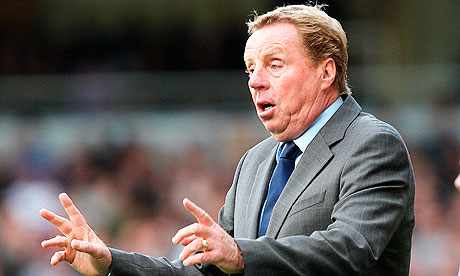
Harry Redknapp, Tottenham Hotspur manager
Harry Redknapp, filmed secretly giving Tottenham Hotspur players tactical instruction. Photograph: Matthew Impey/PA Wire/Press Association Images

Mention Harry Redknapp and tactics in the same breath and the general reaction tends to be a snigger. Either that or those who refuse to believe football is a game that should ever be given more than cursory thought get all excited and claim that Redknapp's successes prove that talk of tactics is all nonsense and that you should just pick your best 11 players and tell them to get on with it.

Neither response makes much sense. Tactics, for something so often written off as boring and nerdish, seem to provoke an oddly emotive response, as any glance through the comments under previous Question pieces will show. Talking about them, apparently, is taking the fun out of the game, over-intellectualising it, robbing it of its soul, football's equivalent of somebody stopping the tape near the end of Casablanca or Cinema Paradiso and explaining that it's all just pheromones, actually.

Presumably nobody, though, actually thinks a team of 10 centre-forwards and a goalkeeper would win a game; once you've accepted there is a need to balance defence and attack, a tactical element has been introduced. Equally, it would be absurd to claim tactics are the only thing that matter, but they provide the basic structure of each game and, alongside ability, motivation, fitness (physical and mental) and luck, are among the key components that determine the result of a game. If Redknapp really is a tactical klutz, he must have had an awful lot of luck.

He is not one of the game's theoreticians, that's true. He is not a Viktor Maslov, a Rinus Michels or an Arrigo Sacchi – but so what? He does what he does. He is probably a better motivator than he is a tactician, just as Rafael Benítez is a better tactician than he is a motivator. But that doesn't mean Redknapp is clueless, even if it at times it suits him to set himself up as the bluff English alternative to all the sophisticated foreign mumbo jumbo, a line that always plays well with the media he courts so superbly.

That is not to suggest, though, that Redknapp is secretly issuing minutely detailed tactical instructions behind the scenes. "There are no long and boring speeches about tactics, like I was used to at Real Madrid," Rafael van der Vaart said in a recent interview. "There is a clipboard in our dressing room, but Harry doesn't write anything on it. It's not that we do nothing – but it's close to that."

In his suspicion of theory, Redknapp comes from a long English tradition that extends far beyond football. "Our habits or the nature of our temperament do not in the least draw us towards general ideas," as John Stuart Mill put it. In football, the greatest manager in that strand of English anti-intellectualism was Brian Clough.

The Clough paradigm

Clough was always scathing of those guilty of what he saw as "over-complicating" the game, and regularly used the term "tactics" dismissively, but with him it seems to have had specifically negative connotations; to have referred to stopping the opposition rather than how his own side played. "Tactics," he insisted in Walking on Water, "played very little part in my method of management. I concentrated 90% on how my team played, in preference to wondering about how the opposition would set out their stall."

He may have thought tactics was a dirty word, something fit for only Italians or Don Revie, but the idea he just sent 11 players out on the field and hoped for the best is nonsensical. Although he usually affected indifference to the opposition, there were times when he took specific action to counter them. Alan Durban, for instance, was once given specific instructions to cut out the supply from Mike Bailey to the left-winger David Wagstaffe in a match between Derby and Wolves. In Nottingham Forest's 1980 European Cup final against Hamburg, meanwhile, with Trevor Francis injured, Clough opted to deploy Lee Mills as a fifth midfielder, helping to stifle Kevin Keegan.

Those are micro examples, but Forest's basic style after winning promotion in 1977 was decided during a pre-season friendly against Shepshed Charterhouse, in which Martin O'Neill's performance in a tucked-in position on the right, with John Robertson wide on the left, persuaded Clough that a lop-sided hybrid of 4-3-3 and 4-4-2 was the future. Terry Curran, a right-winger who had been a regular until injury in the promotion season, never played another game for the club. What was that decision rooted in, if not the tactical realisation that fielding two out-and-out wide men was unworkable in the First Division and that, in O'Neill, Forest had a player who could offer balance?

Peter Taylor always insisted that he and Clough discussed tactics regularly, and had done since their days as players together at Middlesbrough. One of their great gifts was their ability to boil that down into simple instructions. They didn't believe in drawing diagrams on blackboards, and they certainly didn't, as Revie did, hand out dossiers on the opposition. "Telling them how to play took no time," Taylor said in his autobiography.

He explained what those instructions would be at Derby. "To [John] O'Hare it was: 'Hold the ball no matter how hard they whack you.' To [Kevin] Hector: 'Watch O'Hare. You've got to be ready when he slips that ball to you.' And to [Alan] Hinton we didn't say any more than: 'Stay wide.'" It sounds simple, and each individual component was, but multiply those components together and the total was devastatingly effective.

During games, it was simply a question of reinforcing those messages. "I'd shout reminders," Clough said, "adjustments when they occasionally got themselves out of position, which is easy to do in the heat of the moment. I'd emphasise the need to keep the ball and pass it forward whenever possible." It sounds simple – it was simple – but it was also a clear tactical manifesto.

Taylor's conception of the game, he explained in an interview in this newspaper in 1972, was – like so many of his generation – inspired by Hungary's 6-3 win over England at Wembley in 1953. Seeing the Brazilian side Santos play a friendly against Sheffield Wednesday in 1962 convinced him of the importance of attacking full-backs, and led Derby 10 years later to break the British transfer record to sign the Leicester City full-back David Nish because he was comfortable advancing with the ball. Viv Anderson continued the theme at Forest.

"The ability to command space is vital in a good defensive system," he said. "By that I mean that a player who is on his own when the opposition has the ball must be poised and capable of assessing whether he should commit himself or funnel back. [Igor] Netto of Russia was the first player I noticed with this. Dave Mackay has it, so have Bobby Moore and Terry Hennessey ... Then there is the ability to play the ball accurately. At Derby everybody has it. It is essential because the game has got to flow. We believe in playing football right from the back. We do not want our forwards to have a service of high and hard balls out of defence which are impossible to control."

None of that requires complex diagrams or lengthy explanations to players, but it is tactics nonetheless. Teddy Sheringham tells of how he was dropped by Clough at Forest and watched the next match with him from the bench. Listening to Clough during the game, he said, he realised the importance of a centre-forward holding the ball up to relieve the pressure on his defence, rather than attempting flicks that might break through the opposition, but might equally surrender possession. Again, just because Clough wasn't scribbling away on a whiteboard doesn't mean he wasn't imparting tactical instructions.

Redknapp in practice

Redknapp is so much of the lineage of Clough that he even deploys the same percentages. "You can argue about formations, tactics and systems forever, but to me football is fundamentally about the players," he began a column in the Sun. "Whether it is 4-4-2, 4-2-3-1, 4-3-3, the numbers game is not the beautiful game in my opinion. It's 10% about the formation and 90% about the players. If you have the best ones and they do their jobs, then they can pretty much play any way you want them to."

Which, leaving aside the question of how, when things are so interconnected, you can separate them to make up such a statistic – or even the irony of using a number to denounce the use of numbers – is fair enough. Of course the best players usually win. Besides, the formation is only part of a team's tactical set-up, something Redknapp acknowledges by adding the caveat "if they do their jobs". Those jobs, whether it is acknowledged or not, are tactically determined. Even his famed instruction to Roman Pavlyuchenko to "fucking run about a bit" let the striker know he wanted him to play as a mobile front man, looking to drag defenders out of position, and wasn't particularly different in essence to the instructions Clough and Taylor handed out at Derby.

The same applies to the comment John Giles makes in The Football Man that was helpfully quoted in the comments section last week. "The fact remains that the ball is the most important thing on the pitch," he said, "that good players will take up correct positions in relation to it, while bad players will continue to take up poor positions, regardless of tactics or formations." But to determine whether a position is good or bad itself requires tactical understanding.

And whatever Redknapp says, he has proved himself tactically astute at times this season. In the away leg of the Champions League play-off, Spurs were unsettled by Young Boys' high pressing, and could have been annihilated before half-time. Redknapp withdrew Benoît Assou-Ekotto to add an extra holding midfielder in Tom Huddlestone, dropping Gareth Bale back to left-back, which steadied the ship, then brought on Niko Kranjcar for Modric, giving Spurs a player who naturally cuts in from the left, adding midfield solidity and creating a pathway for Bale's surges. 3-0 was transformed into 3-2, a deficit Spurs rapidly wiped out in the second leg.

Against Aston Villa, Spurs, having begun with a 4-4-2 with Van der Vaart on the right and Peter Crouch and Pavlyuchenko as twin strikers, trailed 1-0 at half-time. Off came the Russian, on went Aaron Lennon, while Van der Vaart, who had been drifting infield anyway, took up a central role just behind Crouch. With a direct opponent, Stephen Warnock was pinned back, and Villa lost much of their thrust down the left. Van der Vaart, involved in more dangerous areas and revelling in playing off Crouch, scored twice.

Then at Arsenal a week ago last Saturday, Redknapp made the opposite change, bringing on Jermain Defoe for Lennon and pushing Van der Vaart out to the right from a central role. This time, of course, Redknapp was happy to talk tactics. "I changed it at half-time, opened it up even more really – stuck Rafa out on the right, and brought Jermain on to give us two targets upfront," he said. "In the first half I played with two wingers, and we were stretched … I've got a front man up there, with Rafa in behind, when we lost possession they outnumbered us in midfield and played through us and played around us, and we had to narrow it up in the second half."

The ability to turn games round has been a feature of Tottenham's season. That speaks volumes for their self-belief and powers of resilience, but Redknapp must also take credit for his tactical changes. Of course the corollary to that is to ask why they so often fall behind; and perhaps it's that Redknapp is better at intuitively understanding a game and feeling what needs changing than he is at envisioning a match beforehand.

How far the open, attacking approach can carry Spurs in Europe remains to be seen; Manchester United were once similarly expressive, even won a treble by being so, before one too many goals conceded against the run of play finally convinced Sir Alex Ferguson into caution. But whatever happens to Spurs in the Champions League the idea that Redknapp exists in a world remote from tactics is just wrong.

____________________________________________

Is Harry Redknapp a master tactician or just lucky?

December 1, 2010
By Guest Writer

By Thomas Levin

Harry Redknapp is the first to admit that he is doesn’t do football tactics; calling him an intelligent tactical master will probably offend him as much as calling him a ‘Wheeler Dealer’. His view is that you should pick the best eleven players and tell them to go on the pitch and run around, an approach Rafael van der Vaart proclaims has been the secret to his good form:

“There are no long and boring speeches about tactics, like I was used to at Real Madrid. There is a clipboard in our dressing room but Harry doesn’t write anything on it.”

Redknapp doesn’t share the wisdom of his decision with his players, but does that really mean that Harry Redknapp has built a solid career in top flight football without ever really giving much attention to tactics?

Harry seems quick to distance himself from any intelligent decision making, making websites such as this one or Zonal Marking to be nothing more than futile exercises over-complicating a game with 22 men and one ball.

But Redknapp is not as stupid as he wants to make himself out to be. Of course he is tactically aware; the capture of van der Vaart demonstrates this perfectly. His frivolous spending of course could explain the Dutch playmaker’s introduction to the Premier League, but it has made them a stronger force as they look to compete in Europe on a regular basis and has transformed them into a side tipped to compete for the title.

The domination of the midfield being so important in modern football, has forced the most English of English managers to change his formation from a 4-4-2 to a 4-5-1, especially when up against the elite of Europe.

Tactics can often be explained by finding patterns of play. If left to the players themselves even the best of men will be lost without instruction or organisation. The changes at the Emirates in the London derby, putting van der Vaart on the wing, utilising his natural tendency to come inside narrowed the pitch and made it much more difficult for Arsenal to play their passing game. Spurs threw more forward to attack Arsenal and their inability to see out a lead and their dodgy defence crumbled.

What about the long balls to target man Peter Crouch who knocks it onto the deep runs of van der Vaart? Would this not be classed as a tactical decision? Utilising the players he has and giving them roles that would give synergy to their strengths and attack the weaknesses of the opposition.

To me Harry Redknapp’s “tactics don’t win you games” comments are nothing more than fitting in with a culture that is thankfully slowly dying in football, that of a fear of the educated and the intelligent in football. Long has it been feared in the game where the managers intuition has ruled. The Premier League is quickly becoming a place of in-depth analysis, crunching of numbers and close consideration of everything that happens on and off the pitch. Even Sam Alladyce can pride himself on using the information in front of him to get more out of his players.

Football isn’t won solely on tactics, but it is one part of a huge strategy that is taken into consideration by all managers when their team takes the football pitch, and just turning up with a team sheet won’t cut it.

By keeping things simple and recruiting good players, allowing them to play their natural game (Harry has rarely tried changing the way a player plays his football) Redknapp is showing his man-management skills. Not letting them worry about the bigger tactical picture, but on letting them be free to do what they enjoy.

While Harry’s tactical astuteness is as good as any top Premier League boss, he picks a squad of players that can play the system well. He can identify ready made players who will adapt to a successful way of playing football. This may be one of the reasons why he has very rarely brought through young players up the ranks.

I am not Harry’s biggest fan but I think we need to give his tactics credit, even if he refuses to acknowledge them.

Tactics: Herrera’s Inter

Catenaccio Revisited: Herrera’s Inter

October 19, 2010
By Joshua Askew

You can’t help but feel sorry for Inter. For one of the biggest clubs in Italy, they aren’t all that great. What other club could make the likes of Dennis Bergkamp, Roberto Baggio and Andrea Pirlo look rubbish? And when they are great, they do it in such a way as to make them near-universally disliked. Rather than respect or admiration, Inter mostly incur either pity or loathing.

Inter’s dominance after Calciopoli was always going to be questioned without success European success. With their main challengers severely weakened, you could be forgiven for thinking that Inter were only champions by default – they needed success against proper opponents to prove their quality, and consistently failed to do so under Roberto Mancini, never making it past the quarter-finals.

Enter Jose Mourinho. The confrontational self-proclaimed “Special One” was exactly what Italian football needed for its post-Calciopoli self-loathing, and was also what Inter needed. As clichéd as it sounds, Mourinho is one of those people who seems born to win. His pragmatic focus on system and defensive organisation above entertaining football; his psychological manipulation of players; his constant posturing, whether genuine or not, always keeping the eye on him rather than his team, ensuring they are relieved of a lot of pressure.

The focus on him inevitably meant that when Inter became the first Italian club to win the treble, it was his victory rather than the players’; it was his system rather than the players within it that had won the trophies; it was his man-management rather than their professionalism that had allowed it to work. He was the epitome of the modern manager – the most important man at the club. While Inter under Mancini could easily be known as Ibra’s Inter, the treble-winning side was without doubt Mourinho’s Inter, and it all seemed eerily familiar.

He was born on a white island in the Rio de la Plata or on the Tigre, nobody is quite sure when… the world was his country: he chose to be a foreigner, different, everywhere … he spoke a strange mixture of idioms, French, Spanish, English and Arabic. – Fiora Gandolfi

Born in Argentina to a Spanish trade-unionist – when exactly nobody is quite sure, but it’s supposedly sometime between 1910 and 1916 - Helenio Herrera grew up in Morocco and became a footballer in France. A decent if unremarkable defender, he was called up for the French national team twice, however the only thing of real interest to come from his playing days was his claims of being the first player to play as a sweeper.

“It was when I was in France, it was about 1945 and we were playing like this [in a W-M formation]. With 15 minutes to go, we were winning 1-0. I was the left-back, so I tapped the left-half on the shoulder, and said “you take my place, and I’ll go here behind the defence.” And we won, and when I became manager, I remembered that.”

There are few reasons other than his devilish personality to doubt Herrera – after all it is possible that two people can think of the same thing at the same time without it being plagiarism, particularly when global communication was not at the standards of today – but it was Austrian coach Karl Rappan whose verrou system involves the first notable example of the sweeper, or verrouilleur as it was known by the Swiss press. While Herbert Chapman’s W-M system had dropped the centre-half of the 2-3-5 back into the centre of defence, Rappan pushed the wing-halves back with the full-backs moving to the centre. With the wing-halves dealing with the wingers, the centre-half handling the inside forwards (this outnumbering was a problem solved by the defence dropping deep and marking tightly, essentially ceding the midfield), this left two central defenders marking just one man, so one would drop back, stationing themselves just in front of the goalkeeper, to cover.

The first appearance of the catenaccio system from the conflicting stories in Italy point towards Salernitana’s Gipo Viani, nevertheless it was Nereo Rocco who was the most impressive early exponent. After transforming Triestina and Padova, Rocco took over at AC Milan and won Serie A in his first season and the European Cup in his second. If Viani had introduced the system, Rocco had proven that it could work with big clubs, however it was Herrera who showed it to the world.

Herrera noted the success that others were having with catenaccio and finely honed it – the base of the system was on the strict man marking and the reserve screening of the sweeper. Herrera added a little twist; for La Grande Inter, the full-backs would attack, adding greater flexibility to counter-attacking. We take attacking full-backs for granted now, but it was revolutionary at the time – think about the way Italy were unequipped to combat Carlos Alberto for his famous goal, then consider Inter had been doing that for years under Herrera. This allowed Inter to overload the opposition in defence and in attack.

The key to this was, of course, the players – the tall thin Giacinto Facchetti was spotted by Herrera playing as a forward for Trevigliese’s youth side and brought to Inter. Any doubts over the gangly youngster were immediately dispelled once he took to the field – other than his considerable defensive talents, his ability to sprint 100 metres in just 11 seconds ensured the rapid switching of defence to attack necessary for Herrera’s system to work was present. Herrera had such great faith in his full-back that he declared he would be the first of his players to make it into the national team, doing so at 20 at a time when Italy was wary of giving international opportunities to young players.

On the other side was Brazilian Jair da Costa, tasked alone with covering the entire right flank for Inter. There appears to a misconception that he was a full-back who attacked like Facchetti, most likely down to our tendency to note formations as symmetrical, when rather he was a tornanti – a winger who tracked back. Rather than any sort of tackling ability, Jair used his skill at reading the game to anticipate opposition moves and cut them out. Like Facchetti, Jair was blessed with the blistering pace and the stamina that allowed him to patrol that right flank, however he was an even more adept attacker than the Italian, embarrassing defenders easily to whip in a cross or get a shot away.

Alongside them were the uncompromising Tarcisio Burgnich and the elegant Aristide Guarneri, both playing as stoppers, with Armando Picchi sweeping up behind them. Starting his career as a full-back, Guarneri had a better technique than his more aggressive partner, but upon his signing for Inter he was switched to the centre, using his speed, positioning and tremendous aerial ability to stop whichever forwards he faced. Alongside him was the more tenacious Burgnich; while lacking some the more refined aspects of Guarneri’s game, he made up for it with his ragged determination and strength, immortalised in a quote from Pelé: “I told myself before the game, ‘he’s made of skin and bones just like everyone else’ — but I was wrong.” With Jair so often high up the pitch, Burgnich played wider than Guarneri, acting as a right-back.

With four defenders tasked with stopping the attacker, Herrera set up his own supposed creation behind them - again with a twist from what had come before. Although a far cry from the likes of Gaetano Scirea and Franco Baresi, iconic captain Armando Picchi was one of the first liberi to engage in attacking activities.

Until then, the sweeper position was inhabited by players like Ivano Blason – who would famously draw a line on the pitch and tell opposition forwards they weren’t allowed to cross it – good albeit clumsy defenders. If the defenders were the bolted door, they were an axe-wielding maniac guarding it. Picchi, on the other hand, would start attacks with a long accurate pass or stride forward towards the midfield, occasionally passing the half-way line but not popping up in the box as those that followed him did.

In front of the defence sat Gianfranco Bedin, the self-defined “role player.” Despite his good technique, he was pretty much the stereotypical ball-winner: he was reared to do the dirty work in midfield, tirelessly closing down opponents from the beginning of a match to the end. Home-grown and humble, like many defensive midfielders he wasn’t as celebrated as his more spectacular teammates, who would often credit him for his hard work.

This defensive base was balanced out with some of the greatest attacking talents the game has seen. Bedin’s midfield partner Luis Suárez followed Herrera from Barcelona for a world record fee and became the heart of Inter. Arguably the greatest passer the game has ever seen, his vision and long incisive balls were the key, along with Facchetti and Jair, to Inter’s counter-attacking. Other than possibly Jair collecting the ball deep and steaming into the huge space in front of him, the most frequent move Inter used once regaining possession was giving it to Suárez for him to ping towards Sandro Mazzola, the striker or the advancing Jair.

Plodding down the left was Mario Corso. Lazy (although not nearly as much as Herrera would have you believe) and inconsistent, he was never going to get along with Herrera but, despite his coach’s pleading, Corso was kept on – he was one of Inter owner Angelo Moratti’s favourites and he wouldn’t let him go. Even though Herrera was not fond of him, Corso played over 400 times for Inter and was capable of unlocking defences with “God’s left foot”. He also served a great tactical purpose by allowing Facchetti to play higher up the pitch; whether cutting in to shoot at goal or pulling off one of his trademark “falling leaf” crosses, he ensured that the opposition winger would have to track back, meaning that the man that Facchetti was tasked with marking played deeper so Faccheti would be higher up the pitch, closer to goal.

Sandro Mazzola, son of Torino star Valentino, played in a slightly withdrawn trequartista position. He was, however, the main goalscorer of La Grande Inter, mostly from close range or mazy dribbles, as the main striker – whether that be Aurelio Milani, Joaquín Peiró or Beniamino Di Giacomo – was generally the odd man out, because he simply wasn’t all that special. Their main job was to occupy the defenders enough to help Mazzola. The exception to this was Argentinian Antonio Valentin Angelillo, whose 33 goals in 33 appearences for Inter in 1958-59 remains a record, but Herrera disapproved of his lifestyle and he was sold on.
The system was exposed in the 1967 European Cup final against the attacking football of Celtic’s Lisbon Lions. They went one up with a penalty from Mazzola and shut up shop as usual. It didn’t work. Inter’s four defenders marked the attacking band of Celtic’s 4-2-4, but Celtic had attacking full-backs too – Bobby Murdoch passed it out to Jim Craig who cut it back for left-back Archie Gemmell. It was not possible to mark everybody without losing all attacking presence, and the problems of being outnumbered in midfield still hadn’t been solved.

Herrera blamed the players; he sold Guarneri and Picchi, who left with some stinging criticism of Herrera: “When things go right, it’s because of Herrera’s brilliant planning. When things go wrong, it’s always the players who are to blame.” The next season Inter finished 5th and he left for Roma.

Tactics: Why is Carlos Tevez so vital to Manchester City?

The Question: Why is Carlos Tevez so vital to Manchester City?

His goals help, but it is more than just that – the Argentinian is the ultimate team man, perfect for the central role in City's 4-3-3


Carlos Tevez of Manchester City
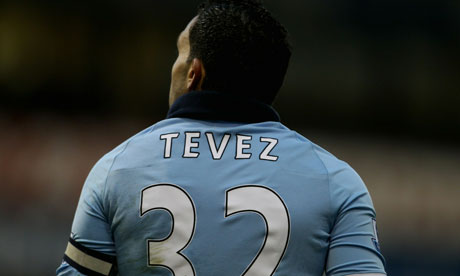
One of Carlos Tevez's great strengths is his selflessness, his willingness to vacate central positions to create space for others. Photograph: Scott Heavey/Getty Images

Manchester City with Carlos Tevez and Manchester City without Carlos Tevez are two different teams. Since Roberto Mancini took over shortly before Christmas last year, City have played 32 games in which Tevez has been on the field for at least 45 minutes, and 11 in which he has not. Of the games he has played, City have won 20, drawn five and lost seven; in games he hasn't, they have won three, drawn four and lost four. The difference becomes even more startling when you consider that two of those wins without him were home ties in the Europa League. So why is Tevez vital to City? His goals help, of course – 24 from open play plus seven penalties since Mancini took over – but it is more than just that; he is perfect for the central role in the Italian's 4-3-3 system.

The Argentinian's final season at Manchester United was bizarrely underrated, rooted largely in the obsession with goal stats. Because he managed only five league goals, he was deemed somehow a failure. "You want more than that for £25m," became a common and infuriating refrain. That season, Cristiano Ronaldo scored 18 league goals, Wayne Rooney 12, Dimitar Berbatov nine; United weren't exactly lacking in potency. Tevez often played wide or deep, and his role became far more about creating than scoring goals. One of his great strengths, in fact, was his selflessness, his willingness to vacate central positions to create space for others, particularly Ronaldo, to score.

The contrast with Ronaldo, in fact, is telling: on Sunday against Atlético Madrid, he once again showed his astonishing self-obsession, shooting from increasingly preposterous positions just because he hadn't scored, as though his personal battle with Lionel Messi was more important than making sure of a Real Madrid win, or improving their goal difference. Tevez's instinct is to the team, and it was notable that after Mario Balotelli had put City ahead against West Bromwich Albion, his first reaction was to turn to Tevez and thank him for the cross; he knew that Tevez could have turned and thrashed the ball at goal, and appreciated the intelligence that led him instead to pull a cross along the six-yard box.

Making Tevez captain was a controversial move by Mancini, given his lack of English and their uneasy relationship, but on an emotional level it makes total sense. Tevez has made huge amounts of money from football, but for a team that could easily become a bunch of disparate mercenaries – if Stephen Ireland is to be believed, it has already gone that way – it is probably as well to have a captain who, in a football sense at least, so obviously cares about winning above all else.

Tevez's leadership, though, is also tactical. His energy and willingness to close opposing defenders down begins the press; he is both an inspiration, his example leading others to greater effort, but also, as Johan Neeskens was for Holland, the initiator. Once Tevez goes (and City don't operate a full-press), the rest follow.

Perhaps most important, though, is his movement. At United, Tevez seemed to suffer from reverse-Berbatov syndrome, his efforts derided as covering for his occasional heaviness of touch, as though the whole running-about thing were a smokescreen. Traditionalists wanted him, as a forward, to spend more time in the box. But it is precisely that willingness to come deep or pull wide that makes him such an asset to City.

When Emmanuel Adebayor plays, City have an aerial option; they can thump the ball long and rely on him to hold the ball up. But when he is there, they can become static, which is a particular problem given the make-up of their midfield. The first-choice trio, which played at West Brom on Sunday, has Nigel de Jong the deepest lying, with Gareth Barry and, particularly, Yaya Touré, given some licence to push forward. Barry, of course, has played as a left-sided midfielder, and can cross a ball. At Beveren, Metalurh Donetsk and Olympiakos, and to an extent Monaco, Touré was more of a box-to-box player than he became at Barcelona, but that does not make him an attacking midfielder. Generally, it is a midfielder built on muscle and energy rather than finesse.

In Italy in the late 90s, it was common for sides to play what was known as "a broken team" with seven defensive players and three attacking and very little in between, something that made the playmaking role both vital and incredibly difficult. Alberto Zaccheroni's scudetto-winning Milan of 1998-99, for instance, played a 3-4-3 that featured a front two of George Weah and Oliver Bierhoff, with Leonardo just behind. Occasionally Thomas Helveg or Christian Ziege would get forward from wing-back to support, but the two central midfielders, Demetrio Albertini and Massimo Ambrosini, were largely defensive. At Juventus, similarly, Zinedine Zidane, Alessandro Del Piero and Filippo Inzaghi were backed up by the industry of Edgar Davids, Didier Deschamps, Angelo Di Livio and Antonio Conte.

With a more systematised approach – whether attacking or defensive – taking over in the past decade, there was a move away from the broken team, but the example of Holland and, to a lesser extent, Argentina and Germany at the World Cup suggested it was returning. Intriguingly, the trend has coincided with the apparent rebirth of the playmaker – Mesut Ozil, Wesley Sneijder, Lionel Messi (as Argentina used him) – both, perhaps, products of the liberalised offside law. That is understandable at international level, given the lack of time available to drill players into a system; at club level the approach feels a little rudimentary.

Tevez, though, makes it work, as he almost defines the role of the false nine. His movement prevents the team breaking up, providing a link with the midfield, and as he drops deep, so he can interact with Touré or Barry. That is not natural to Adebayor – very much a real nine – and the difference in their approach is seen here. Adebayor did drop deep and pull wide, but far less than Tevez, and against Wolves he attempted only just over half the number of passes Tevez did against West Brom.

Tevez's movement also encourages those around him to move. Mancini has an array of forwards capable of playing wide: David Silva, Mario Balotelli, James Milner, Adam Johnson, and Shaun Wright-Phillips, but City look at their most effective when at least one of them is inverted and able to cut inside into the space vacated by Tevez, as Balotelli did to great effect on Sunday.

The theory is simple: the back four defends with only occasional forays from the full-backs; the three midfielders dominate possession, and if they can't, they sit deep to provide an extra layer of defensive cover; and a fluid front three tries to turn the possession into chances and goals. Tevez, though, adds something extra, linking the two parts of the team, and making the whole more fluent. He scores goals, but more important is that he lubricates the whole mechanism.

Tuesday, November 9, 2010

Tactics: Are Barcelona reinventing the W-W formation?

The Question: Are Barcelona reinventing the W-W formation?

To counter teams who sit deep, Barça push both full-backs up the pitch – echoing the 2-3-2-3 formation of the 1930s


Barcelona players celebrate
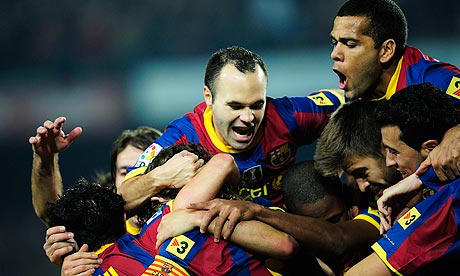
Barcelona players celebrate yet another goal. Photograph: Manu Fernandez/AP

Football is a holistic game. Advance a player here and you must retreat a player there. Give one player more attacking responsibility and you must give another increased defensive duties. As three at the back has become outmoded as a balanced or attacking formation – though not as a defensive formation – by the boom in lone-striker systems, coaches have had to address the problem of how to incorporate attacking full-backs without the loss of defensive cover.

For clubs who use inverted wingers, as Barcelona do, the issue is particularly significant. For them, the attacking full-back provides not merely auxiliary attacking width but is the basic source of width as the wide forwards turn infield. The absence of an Argentinian Dani Alves figure in part explains why Lionel Messi has been less successful at national level than at club level. For Barcelona, as he turns inside off the right flank, Alves streaks outside him, and the opposing full-back cannot simply step inside and force Messi to try to use his weaker right foot. Do that, and Messi nudges it on to Alves. So the full-back tries to cover both options, and Messi then has time and space to inflict damage with his left foot.

It is the same if Pedro plays on the right flank, and the same when David Villa plays on the left. Barcelona's wide forwards are always looking to cut inside to exploit the space available on the diagonal, and that is facilitated if they have overlapping full-backs. Traditionally, if one full-back pushed forwards the other would sit, shuffling across to leave what was effectively a back three.

Barcelona, though, often have both full-backs pushed high, a risky strategy necessitated by how frequently they come up against sides who sit deep against them. With width on both sides they can switch the play quickly from one flank to the other, and turn even a massed defence. They still, though, need cover in case the opponent breaks, and so Sergio Busquets sits in, becoming in effect a third centre-back.

That, of course, is not especially new. Most sides who have used a diamond in midfield have done something similar. At Shakhtar Donetsk, before they switched to a 4-2-3-1, Dario Srna and Razvan Rat were liberated by Mariusz Lewandowski dropping very deep in midfield. At Chelsea, Luiz Felipe Scolari would often, when sketching out his team shape, include Mikel John Obi as a third centre-back. And Barcelona themselves had Yaya Touré dropping back to play as a centre-back on their run to the Champions League trophy in 2008-09.

What is different is the degree. It is not just Barcelona. I first became aware of the trend watching Mexico play England in a pre-World Cup friendly. Trying to note down the Mexican formation, I had them as four at the back, then three, then four, then three, and I realised it was neither and both, switching from 4-3-3 to 3-4-3, as it did during the World Cup.

Ricardo Osorio and Francisco Rodríguez sat deep as the two centre-backs, with Rafael Márquez operating almost as an old-fashioned (by which I mean pre-second world war) centre-half just in front of them. Paul Aguilar and Carlos Salcido were attacking full-backs, so the defence was effectively split into two lines, a two and a three. Efraín Juárez and Gerardo Torrado sat in central midfield, behind a front three of Giovani dos Santos, Guillermo Franco and Carlos Vela. The most accurate way of denoting the formation, in fact, would be 2-3-2-3: the shape, in other words, was the W-W with which Vittorio Pozzo's Italy won the World Cup in 1934 and 1938.

Of the same species as Pozzo

Pozzo first latched on to football while studying the manufacture of wool in Bradford in the first decade of the last century. He would travel all around Yorkshire and Lancashire watching games, eventually becoming a fan of Manchester United and, in particular, their fabled half-back line of Dick Duckworth, Charlie Roberts and Alec Bell. All centre-halves, he thought, should be like Roberts, capable of long, sweeping passes out to the wings. It was a belief he held fundamental and led to his decision, having been reappointed manager of the Italy national team in 1924, immediately to drop Fulvio Bernardini, an idol of the Roman crowds, because he was a 'carrier' rather than a 'dispatcher'.

As a result, Pozzo abhorred the W-M formation that his friend Herbert Chapman, the manager of Arsenal, developed after the change in the offside law in 1925, in which the centre-half – in Arsenal's case Herbie Roberts – became a stopper, an 'overcoat' for the opposing centre-forward. He did, though, recognise that in the new reality the centre-half had to take on some defensive responsibilities.

Pozzo found the perfect player for the role in Luisito Monti. He had played for Argentina in the 1930 World Cup but, after joining Juventus in 1931, became one of the oriundi – those South American players who, thanks to Italian heritage, qualified to play for their adopted country. Already 30 when he signed, Monti was overweight and, even after a month of solitary training, was not quick. He was, though, fit and became known as Doble ancho (Double wide) for his capacity to cover the ground.

Monti became a centro mediano (halfway house) – not quite Charlie Roberts but not Herbie Roberts either. He would drop when the other team had possession and mark the opposing centre-forward, but would advance and become an attacking fulcrum when his side had the ball. Although he was not a third back, he played deeper than a traditional centre-half and so the two inside-forwards retreated to support the wing-halves. Italy's shape became a 2-3-2-3, the W-W. At the time it seemed, as the journalist Mario Zappa put it in La Gazzetta della Sport, "a model of play that is the synthesis of the best elements of all the most admired systems", something borne out by Italy's success.

Footfalls echo in the memory

To acknowledge that modern football's shape at times resembles the 1930s, though, is not to repeat Qohelet, the author of Ecclesiastes, and lament the futility of a world without novelty: "What has been will be again, what has been done will be done again; there is nothing new under the sun. Is there anything of which one can say, 'Look! This is something new'? It was here already, long ago; it was here before our time." Nor is it to argue that tactics are somehow cyclical, as many bewilderingly do.

Rather it is to acknowledge that fragments and echoes of the past still flicker, reinvented and reinterpreted for the modern age. Like Mexico, Barcelona's shape, at least when they use only one midfield holder, seems to ape that of Pozzo's Italy. Those who defend three at the back argue that, to prevent the side having two spare men when facing a single-striker system, one of the centre-backs can step into midfield, to which the response is few defenders are good enough technically to do that, and why not just field an additional midfielder anyway? What Barcelona and Mexico have done is approach the problem the opposite way round, using a holding midfielder as an additional centre-back rather than a centre-back as an additional midfielder.

But the style of football is very different. It is not just that modern football is far quicker than that of the 30s. Barcelona press relentlessly when out of possession, a means of defending that was not developed until a quarter of a century after Pozzo's second World Cup. In the opening 20 minutes at the Emirates last season when Barcelona overwhelmed Arsenal, the major difference between the sides lay not in technique but in the discipline of their pressing.

Inverted wingers, similarly, would have been alien to Pozzo: Enrique Guaita and Raimundo Orsi started wide and stayed wide, looking to reach the byline and sling crosses in. Angelo Schiavio was a fixed point as a centre-forward – no dropping deep or pulling wide for him. The two wing-halves, Attilio Ferraris and Luigi Bertolini, would have been too concerned with negating the opposing inside-forwards to press forward and overlap.

Nonetheless, the advantages of the W-W for a side that want to retain possession, the interlocking triangles offering simple passing options, remain the same. Having Busquets, the modern-day Monti, drop between Carles Puyol and Gerard Piqué is not just a defensive move; it also makes it easier for Barcelona to build from the back. Against a 4-4-2 or a 4-2-3-1, Busquets can be picked up by a deeper-lying centre-forward or the central player in the trident, which can interrupt Barcelona's rhythm (just as sides realised after Kevin Keegan had deployed Antoine Sibierski to do the job, that – counterintuitively – Chelsea could be upset by marking Claude Makélelé); pull Busquets deeper, though, and he has more space to initiate attacks.

There is a wider point here, which relates to notation. Looking at reports from the early 70s, it seems bizarre to modern eyes that teams were still listed as though they played a 2-3-5, which had been dead for the best part of 70 years. Yet that, presumably, was still how journalists and their readers thought. Future generations may equally look at our way of recording formations and wonder how we ever thought it logical that a team playing "a back four" could feature fewer defensive players than a team playing "a back three".

We understand that full-backs attack and that in a back four the two centre-backs will almost invariably play deeper than their full-backs, but the formation as we note it does not record that. Barcelona tend to play a 4-1-2-3 or a 4-2-1-3, according to our system of notation; heat maps of average position, though, show it as a 2-3-2-3. Barcelona, like Mexico, play a W-W, but not as Pozzo knew it.

Popular Posts

Labels

188Bet (2) Alberto Aquilani (1) Andre Villas Boas (2) Andy Carroll (1) Aragones (1) Babel (1) Barcelona (1) Barnes (1) blogs (1) Brad Jones (1) Brendan Rodgers (2) Capello (2) Casillas (2) Cristiano Ronaldo (1) Dalglish (5) Dalla Valle (1) Daniel Agger (1) Del Bosque (2) Diego Maradona (2) Eto'o (1) Euro08 (1) Everton (1) Evra (1) Fergie (2) Fernando Torres (5) Fitness (1) Football tactics (46) Freak Goals (1) funny (2) Gaffs (1) Gary Lineker (1) Gerrard (4) Guardiola (3) Harry Redknapp (1) Herrera (1) Highlights (1) Hillsborough (2) Hodgson (3) Howard Webb (1) Jan Molby (2) Javier Mascherano (2) Joe Cole (1) John Aldridge (2) John Barnes (1) Jonjo Shelvey (1) Jordan Henderson (2) Jose Segura (1) Juan Mata (1) Just for a Laugh (1) Kenny Dalglish (7) Kolo Toure (1) Kuyt (3) LeBron James (1) Level 3 (2) Lionel Messi (3) Liverpool FC (1) Lucas (4) Lucas Leiva (2) Luis Enrique (1) Luis Suarez (9) Mancini (1) Martin Skrtel (2) Maxi Rodriguez (1) micha (1) Michael Owen (2) Michels (1) Mourinho (3) Owen (1) Pablo Aimar (1) Patrice Evra (1) Pennant (1) Pepe Reina (1) Philippe Coutinho (2) Pre-season (1) Rafa (46) Ralf Rangnick (1) Ramos (1) Reina (2) Rodolfo Borrell (1) Roy Hodgson (14) rumours (1) Sacchi (2) Sebastian Coates (1) Shankly (1) Skills Challenge (3) Squad size (1) Squad worth (1) Steven Gerrard (2) Stewart Downing (2) Tevez (1) Thierry Henry (1) Thommo (1) Tomkins (12) Torres (3) Transfers (4) TV Competitions (3) UK Academy system (1) Xabi Alonso (2) youngsters (4) Youtube Scout (7) Zonal Marking (2)

Quote of the moment

Defying belief however, is a market Benitez has cornered quite well. The moment you think Benitez is clueless, he defies it by pulling off a result of majesty, like the one achieved in Madrid. The moment he is hailed a genius, he masterminds toothless surrender to a team going nowhere. In the ongoing Anfield power struggle, just when he was cornered by the firing squad, the Spaniard's demise at Liverpool looking practically assured with the ominous suspension of betting by the bookmakers, he squeezes out through a narrow trapdoor and eliminates Rick Parry. Rafa Benitez is Keyzer Soze.
- Just Football blog: The Curious Beast that is Football 28 Feb 2009