Just been appointed WBA manager. Never liked him managing us. But good luck all the same

Showing posts with label Roy Hodgson. Show all posts
Showing posts with label Roy Hodgson. Show all posts
Friday, February 11, 2011

Wednesday, February 2, 2011
Does Roy Hodgson judge performances purely on shape?

A lot of what he says could be dismissed as generic nonsense to give away as little as possible, and maybe that’s just what it is, but read between the lines and a lot of it gives a valuable insight into his mind-set.
Take this, for example, after the 1-1 draw away to Steaua Bucharest:
“It’s good for me to know the work we’re doing day in, day out on the training field is having some effect and the players are getting more and more comfortable with what we’re trying to do, even those that maybe don’t play every week.”
A fairly innocuous comment intended to praise the “B” team with little actual substance. The players are getting “more and more comfortable” shows his work isn’t done, but that progress is there. “A draw isn’t the best I can do, but give me some time” he appears to be saying. “Even if you can’t see the positives in having only 40% of possession and one shot on target, I can, and it’s based on what we do in training – something you can’t see. You can’t prove that it’s not going to get better, because you don’t what we’re doing.”
Oh, but you’re wrong Roy. Thanks to your journalist buddies, we know all the secrets to your success.
“I don’t believe in innovation,” claims Hodgson. “There are those people who think that training sessions is having lots of different practices that change every five or 10 minutes. This is the last place to come for that.”
“Strangely, football is a sport in which some don’t expect to rehearse or practise. The important thing is that what you are coaching the players to do has direct relevance to what will happen in a match situation.
“There’s a way I do my job. I realise I’m working with individuals but we need to be a team. The fans are coming, not to see me, but the team I prepare.”
“We work on it every day,” said Fulham’s Simon Davies. “Every day in training is geared towards team shape.”
Hodgson’s also admitted his primary influence is former FA technical director Allen Wade, who, in his coaching manuals, attempted to theorise every given match situation. His disciples then went off and drilled this into their players, “dehumanising” them as certain critics put it.
Rafa Benitez used a similar mechanised approach, but focussed much more on the attacking side of play. His players didn’t just use their creativity to score goals, they worked on set patterns of play, like in basketball, to target weak areas of the opposition and grind them down. However, they were based on the players’ strengths. For instance, how often would you see Glen Johnson pick up the ball, move inwards then knock it in between two players and whip in a cross? It was repeated too often not to have been a set pattern, but you never saw Alvaro Arbeloa do it, he was always involved in neat passing moves in the final third.

Hodsgon’s approach is made for players who are neither talented nor smart. The players set up in a deep, narrow, rigid 4-4-2 based on the relationships between players and releasing the ball as quickly as possible. Through endless drilling and rare selection changes, the players become aware of where they are in relation to their teammates and their free thinking gets eroded, or, as Hodgson puts it, “positive brainwashing.” The organisation of the defence makes it difficult for opposing teams to break them down and the releasing the ball quickly allows them to keep mistakes to a minimum.
This system can make poor players like Fulham’s appear better than they are, but players who are talented and intelligent, like, say, Liverpool’s, will struggle because they can think for themselves and simply getting rid goes against everything a talented player stands for – Hodgson’s problem is actually that the squad he inherited from Benitez is too good.
Which brings us back to the original question: is sticking to this rigid shape all Hodgson judges performances on?
His happiness over performances in press conferences would suggest so, but for the sake of argument let’s assume that’s a façade.
In between the back-slapping of mediocrity during an interview with Sky, Hodgson mentioned that Raul Meireles just needed time to adapt, ignoring that the Portuguese had looked brilliant the second he was moved to the centre. Easy to forget about until the Wolves game, where he was shifted back out to the right to make space for Steven Gerrard, a player who’s consistently proven he doesn’t even have half the brain to play there. It doesn’t appear to matter where in the team Meireles plays to Hodgson, as long as he can stay in the shape.
Meireles isn’t an isolated case. It’s obvious that Fernando Torres isn’t suited to having to hold up hoofed balls against five or six players, yet he stays static up front so fulfils his role in the shape. Equally, although looking big and hard, Martin Skrtel isn’t particularly physical or good in the air, preferring to play on the ground, which makes him ill-suited to Hodgson’s style, yet he’s played in every game of Hodgson’s tenure so far. A glance at his transfer record confirms he’s not a very good judge of player.
Any improvement in Liverpool essentially means that the players are actually becoming worse – which makes Paul Konchesky’s slight uptake in form worrying – as it means Hodgson’s methods are having an effect, meaning they will inevitably have to unlearn it when a replacement is found.
Hodgson was brought in to “steady the ship”, but his system means ripping up everything Liverpool had worked on for the last few years for an undoubtedly, at least aesthetically, worse style that puts them right back where they started. Liverpool’s progress has come in distinct stages: Benitez was the highest stage – if he needed replacing, it had to be with someone of a similar level and style. Evolution over revolution. Instead, we got something worse. If Gerard Houllier was John Smith, and Rafa Benitez was Tony Blair, then Roy Hodgson is Gordon Brown.
This was originally intended for Well Red Magazine, although thanks to Roy Hodgson’s sacking it wasn’t necessary, but I thought it might be of some interest to some of you.
Tuesday, January 11, 2011
Roy vs Rafa: Endgame
Source
Following on from his comparisons between last season and this, Andrew Beasley looks at the final 20 league games of Rafa Benítez and Roy Hodgson. A lot was made of the fact that Liverpool weren’t very good in 2010 before the change took place, so this piece examines that belief.
As we all know, Rafael Benitez was sacked as Liverpool manager having finished 7th in the league, which was deemed unacceptable.
The highest position Liverpool managed in the league at any point under Roy Hodgson was 8th, with an average placing of 12.35. He has now also been sacked, after 20 league games.
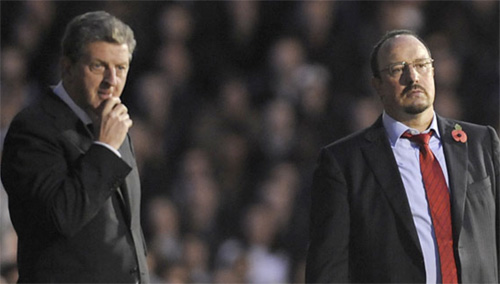
After writing articles earlier in the season comparing Roy’s early efforts against Rafa’s in 2009 (the same fixtures) and 2004 (so both were judged as the new manager), I thought it would be interesting to compare some statistics from their final 20 league games. Obviously in Roy’s case, these were his first (and only) 20 too.
Inevitably in a comparison of this nature, there are differences between the circumstances that the two managers faced which could be used to defend or attack them. For example, Benitez had bought all of the players (aside from the home grown lads) in his squad himself, whereas Hodgson had not.
On the other hand, the ownership issue was resolved during Roy’s tenure, so he should have had a ‘bounce’ from both that and his ‘fresh start’ status as the new manager; Rafa’s position was rapidly becoming untenable due to multiple issues within the club and his management influence had probably grown inevitably stale after nearly six seasons in charge.
Needless to say the fixtures weren’t identical, but both managers played ten home and ten away games, and some of the traditionally big fixtures (Manchester United away and Chelsea at home, as well as matches with Arsenal and Everton).
Understandably, there has been a lot of discussion here and elsewhere about the change in tactics between Rafa’s favoured 4-2-3-1 and Roy’s 4-4-2. More specifically, the shift in emphasis between pressing high up the pitch and defending deeper. But do the possession stats illustrate this at all?
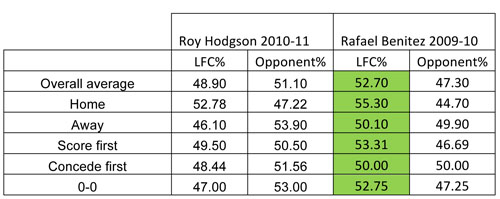
Whichever way you look at it, Benitez’s team had more of the ball than Hodgson’s, and the difference in the two manager’s tactical approaches must surely be the primary reason for this.
In the twenty matches I looked at, Rafa’s Liverpool only had less of the possession in two games. As you’d probably guess, these were the games against Manchester United and Chelsea (a strange game with nothing really left to play for).
By comparison Roy’s team had less of the ball in nine of his twenty matches, and as you might assume, seven of these games were away from home. Ceding possession whilst down to ten men and leading for half a match against Arsenal might be viewed as acceptable, but to have significantly less of the ball against teams such as Wigan (42%-58%), and Stoke (a mind-boggling 36%-64%) is surely not.
Of course, possession alone does not win games. After all, Liverpool had more of the ball in the Merseyside derby this season, yet it made little difference as they lost tamely by two goals to nil. That said, by having more of the ball, it seems safe to assume that you’d be more likely to score and less likely to concede:
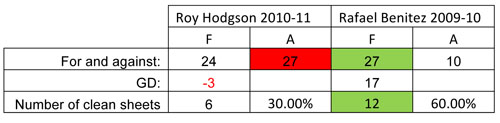
I must admit I was slightly surprised to see that the number of goals scored was fairly similar for the two managers, though clearly Rafa’s team was streets ahead defensively. Obviously these numbers have an impact on the figures regarding scoring and conceding first:

Whilst little of any major interest can be gleaned from these figures, it’s worth taking a closer look at the goals for and against by the same criteria (e.g. matches where they scored or conceded first):
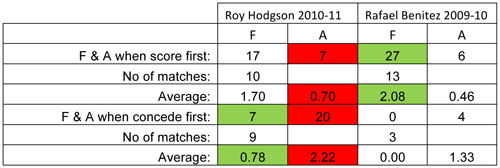
Benitez’s team scored (on average) just over two goals a game when they scored first, which goes a long way to explaining why they won on ten of the thirteen occasions that this happened. Hodgson’s side conceded an average of over two goals whenever they conceded first, and this clearly contributed to the eight defeats from nine matches (the recent Bolton game stopped a complete whitewash of nine defeats on this front). A clear shift in defensive and offensive success had occurred, and if nothing else, this proves just how vital the first goal in the majority of matches is.
In view of this, who defended their leads the best, or clawed back any points from being behind?

Whilst Roy did recover four points from losing positions to Rafa’s zero, he did have eleven occasions (the nine where we conceded first, plus Sunderland at home and Tottenham away) to attempt and save the game to Rafa’s three, so it isn’t too much to be proud of. For the record, Rafa’s team led in thirteen matches to Roy’s eleven.
It wouldn’t be an article of mine without taking a look at the substitution info:
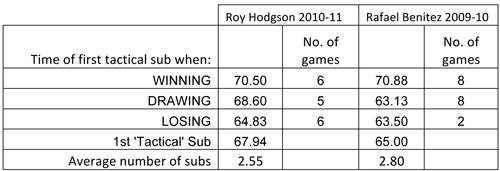
There isn’t necessarily a better or worse time to make a substitution, but the real issue here is one of media consistency. Rafa made more changes and made them earlier on average, yet you never hear accusations of Roy ‘managing by numbers’ or suchlike. I had to smile when I saw that Rafa’s average time for his first tactical substitution across these twenty games was sixty-five minutes, the exact time that Andy Gray et al accuse him of working to. So please don’t tell anyone at Sky what I’ve found!
As I have mentioned previously in match threads on this site, if anything, Roy seems to be guiltier of being limited with the scope of his substitutions. For four games in a row this season (from Blackpool to Bolton) the first substitute brought on was David N’Gog every time, and for three games more recently (West Ham, Spurs and Aston Villa) the first sub was Fabio Aurelio on 73, 74 and 76 minutes respectively. These may be coincidences, but these little statistics suggest to me that Roy had little in the way of a Plan B, which is what many of us suspected all along.
The basic match facts illustrate the two men’s differences as simply as anything can, and are, after all, the ultimate barometers of football success:

Extrapolated over a whole season, Roy would have earned 47.5 points and Rafa 68.4. If you use last season’s final table as a guide, Hodgson’s team would have finished 11th (so slightly ahead of his average placing so far this season) and Benitez’s side would have been 5th. The real point of interest here is that Fulham finished last season with 46 points and only one away win – sound familiar?
I have a multitude of other statistics I could throw at you, but they all basically illustrate the same point: even during arguably his worst period at the club, Rafa was a more effective manager at Liverpool than Roy, and I’m sure you don’t need me to tell you that. At the end of the season, I intend to do a similar comparison between Roy and Kenny’s halves of the campaign.
Why Kenny’s So Right, and Roy Was So Wrong
Source
Roy Hodgson is a good manager. His relative success at certain clubs and his durability over 35 years proves that. However, he was never the right man for Liverpool Football Club.
If that seemed obvious to many of the club’s followers in the summer, it became unavoidable with his comments and tactics, both of which smacked of low expectations and mid-table mediocrity. If he remains a good manager, he proved that he is not a particularly adaptable one. And therefore, allied to his low win percentage in his three biggest jobs and lack of trophies at any of them, he’s not a great manager. Far from it, in fact.
This is a man who said in 2002 that he doesn’t believe in innovation (although perhaps he meant change for change’s sake), and who has proudly stuck to roughly the same methods for 35 years. Those methods – including a very British 4-4-2 formation – work well at clubs full of journeymen who need to be organised into a fighting unit and snatch the occasional victory, but as shown at Blackburn and Liverpool (and also Inter Milan), rather than see his results prosper, he seems to win the exact same percentage of games even when he steps up a level or two.
Maybe he would have adapted with time, but it’s unlikely. It’s baffling how someone with so much experience could make so many ‘rookie errors’ in every area of his performance; and at 63, and not a popular appointment to start with, how much time did he have? He managed to insult the fans, popular former managers and alienate supporters (with his words and his football) to the point where 10,000 empty seats for a New Year’s Day fixture told its own story.
Scott Murray sums up Hodgson beautifully in The Guardian, and Dion Fanning once again hits the nail squarely on the head here. It almost doesn’t need me to add to either of those pieces, but as ever, there are some small details to focus on.
Upon his appointment, Hodgson claimed that he’d get more than his predecessor out of this group of players. Indeed, that was his line in the job interview. Unfortunately, those interviewing him – as non-football men – didn’t know what they were doing.
Hodgson immediately offloaded some skilful ball-players and brought in some mediocre plodders and has-beens. He left out talented individuals like Agger (at the start of the season when everyone was fit) and played his only good signing on the right of midfield, where he performed like a fish out of water. Even after ending Meireles’ torrid time out there, and seeing the Portuguese find his feet – and the team its balance – in the centre, he was inexplicably stuck out there again at home to Wolves, when the last vestiges of hope died in a quite dire display. With the players at his disposal (including five he brought in), he made a right mess.
In returning to the dugout, Kenny Dalglish doesn’t have to prove himself a tactical master; these things are more vital when all is going well, and you need to eke out something extra. Right now, so long as he is sufficiently positive in his approach, and surrounded by the right lieutenants, the key is lifting a black cloud.
Hodgson was our Eyjafjallajökull, smothering us and stopping us getting off the ground.
Reality, Not Romanticism
While it may seem to fans of other clubs that we are living in the past, this is not about romanticism. It’s about uniting the club behind one man. It’s about finding a manager that the players – for 18 months a split group – will get behind.
Last season, Benítez lost the support of some key personnel from as early as the first week of the campaign, while Hodgson never really had the support of others – and almost certainly lost the faith of some of those who were open minded until they encountered his methods. But it’s hard to see anyone objecting to Dalglish.
It’s also about exciting the Kop to produce its full motivational power, rather than finding increasing gaps around the stadium where fans (who had always turned up, even when losing) started to refuse to spend their time and money watching Liverpool play without style or ambition. You can excuse bad games and defeats – you get them in any season – but it was uninspiring, overly cautious stuff from the moment Hodgson arrived.
Let’s not feel sorry for the departed boss. He dug himself into a hole too deep to get out of. Nothing was going to work, because all faith had been lost.
It got to the point where even acknowledging and amending the error of his ways was not going to win over a public who’d seen and heard too much. Even Phil Thompson admitted that he’d not seen the team play particularly well at all this season. Last season was horribly inconsistent, and that ‘did’ for Rafa Benítez, but at least Liverpool won some games with style and something to spare, including victories against Everton and Manchester United. The team were scoring a lot more goals than now, even though it was generally a poor season. That tells you how bad this has been.
As expected, managers are queuing up to say what a travesty the removal of Roy is, with Gérard Houllier saying that it’s now “brutal” and that managers are in the firing line after “losing a couple of games”. The trouble is, in the league, Hodgson lost nine and won only seven, as well as overseeing the worst domestic cup defeat since before Shankly’s time.
Hodgson was appointed under previous owners, by a since-deposed chief executive who began to think himself a football guru. Hodgson made the mistake of trusting that chief executive with regard to player assessments, and between them they messed up the summer’s transfer business. Hodgson seemed to side with Purslow rather than the fans.
Some of the criticism of Hodgson was daft, such as the outrage when he smiled when passing Alex Ferguson on his way to a seat at the JJB last weekend. And some of it got far too personal, as did the attacks on the owners from a few lunatics for not yet having sacked him. Ludicrous stuff.
But when Hodgson should have been putting Liverpool FC before his friendship with Ferguson back in the autumn – when Torres was first called a cheat by the United manager, and then linked with a move to United – he failed to do so. Sometimes diplomacy ends up upsetting someone regardless, because sitting on the fence can imply acceptance of a situation that needs to be spoken out against. (If you refuse to say that your wife is pretty when someone asks, you’ve just insulted her.)
Arsene Wenger said that Hodgson is a ‘great manager’, but how many Arsenal fans would have wanted him to replace the Frenchman this summer if the Gunners had performed badly last season? Seriously, can anyone see that as a sensible approach?
And before people get too snotty and say Arsenal were/are light years ahead of Liverpool, remember that Benítez won a trophy more recently than Wenger, finished in the top two far more recently, reached a Champions League Final more recently, and did so at a club far less stable behind the scenes.
And that’s coming from a huge fan of Wenger, too … Which is precisely the reason why I couldn’t see Arsenal ever appointing someone like Hodgson, or wanting to change from their sensible continental approach ‘for the sake of it’. The knee-jerking at Liverpool was in the summer, in terms of the direction of the club, rather than from the fans or NESV. The knee-jerking was in thinking that because things had gone stale under Benítez, everything about him (or Spanish football) was wrong. Instead of choosing Manuel Pellegrini, the board consciously and deliberately went ‘English’. English manager, more English players. I said in the summer that this was a daft way to go about things.
A lot of mocking supporters of rival clubs seem to think that Liverpool have become the new Newcastle by appointing Kenny Dalglish, after the enmity shown towards Roy Hodgson from the Kop.
The problem was, Liverpool became the new Newcastle in the summer, by doing the classic ‘baby out with the bath water’ 180º u-turn. Undoing that was never going to be straightforward. Hodgson’s position became untenable – the atmosphere surrounding the club was getting unbearable – and in order to buy some time ahead of a permanent summer appointment, there needed to be the best possible kind of release of the building pressure.
Dalglish oversaw arguably the finest football Liverpool (or any other British team) have ever produced, winning the title three times in his five and a half years; and then, by spending money in line with (but not in excess of) Manchester United – see Pay As You Play for evidence – took the title to Blackburn in 1995. It was a long time ago, but it involved some absolutely fantastic signings, and a winning mentality. Even his short-lived time at Newcastle left them with Didi Hamann (sold for a big profit to Liverpool, whom he served with distinction), Shay Given, Gary Speed and Nolberto Solano. (Jon Dahl Tomasson, just a kid at the time, went on to prove what a great player he is over the next decade; it was just too early for him.)
Speaking on LFC TV, The Times’ Tony Barrett mentioned how Fernando Torres was nervous to simply kick a ball in the street with Kenny (following some promotional interviews the legends were doing), such is the awe in which he is held. If Kenny has the right people around him, then that respect, allied to the deep understanding of the game he possesses, can overcome any possibly issues of rustiness.
Modern Thinking
Two years spent at the Academy working with the ex-Barcelona FC gurus Borrell and Segura – where the tactics are far more modern than any Hodgson was implementing – will have brought Dalglish up to date, as will his conversations with Rafa Benítez, of whom Dalglish was a fan.
Indeed, anyone who has been following the youth team since Rafa overhauled the Academy in 2009 will know how much talent there is below the first team squad, and how progressive the approach is. On Saturday, the Reds tore apart a talented Crystal Palace side (top of their Southern league group, I believe, and victors over Arsenal 3-0) in the most one-sided game I’ve seen all season. It ended 3-1 to the Reds, but could have been a cricket score.
It was a beautiful exhibition of football – 4-2-3-1, passing and movement not so different from that of Barcelona – which revolved around the Spaniard wunderkind Suso (the side’s Messi), drifting in from wide areas. (Not saying Suso – who, thanks to Benítez chose Liverpool over Real Madrid – is, or ever will be, as good as Messi, just that, at this level, against boys up to 18 months older, he was on a different planet. Also, see this video clip from last year when, aged just 16, he was showing his talent against senior sides in pre-season friendlies.)
While Hodgson was happy to play some kids in his ‘B’ team, he rarely even picked the likes of Kelly and Pacheco for the bench in the Premier League, even though they are a year older than when they made their debuts last season. Dalglish is very much in touch with the up-and-coming talent on the books, and can link each section of the club. The comparisons with Keegan’s return at Newcastle are especially daft because while Keegan – an inferior manager – was noted for not even following football during his time out of the game, Dalglish has been following it closely.
And while Liverpool lost to Manchester United in Dalglish’s return, it was courtesy of a Howard Webb gift (Agger stuck out a leg but quickly withdrew it) and a moment of madness from Gerrard that left the Reds with ten men. (However committed Gerrard is in big games, he has to learn to stop diving in like that.)
The pleasing thing was that, as I’d expected, Dalglish set up in a modern 4-2-3-1, as opposed to Hodgson’s rigid 4-4-2. The Reds pressed higher up the pitch, even with just ten men, and showed greater movement. The side looked balanced, and everyone was looking to pass the ball. Agger strode confidently out from the back, and although Reina was the busier keeper, Liverpool came out of the game with their pride intact.
So, if Dalglish is a case of ‘going back to the past’, then it was mostly reminiscent of the Liverpool of 2008/09 that won 25 of its 38 league games and lost only two (as opposed to Hodgson’s antiquated, inhibited approach).
Above all else, Dalglish knows what Liverpool fans expect to see. When the Reds were 2-0 down at Manchester City earlier in the season, Hodgson didn’t make a change until the 80th minute, and in other games he left his substitutions very late (because he has never really had a Plan B). At Old Trafford, Kenny made two positive substitutions on 60 minutes.
Will it last beyond the summer? Quite possibly not. But if it goes better than expected, and the right people are brought in around him (Steve Clarke?) – as well as getting on well with Damien Comolli – then the Reds could do worse. After all, and much to our great pain, we’ve just spent the past six months witnessing just that.
Comparison: Roy 2010/11 vs Rafa 2004/05
By Andrew Beasley. Following my recent piece comparing Roy Hodgson’s stats this season with Rafa Benitez’s last season, an idea was posted that I hadn’t considered. As Roy was inheriting Rafa’s squad, how did Rafa get on in comparison when he inherited Houllier’s squad?

Remember, Liverpool lost 18 games in 2003/04, compared with 16 last season. And Liverpool finished last season with 63 points, to the 60 of Houllier’s final season. Houllier’s team also never made it as far as a cup semi-final in his final season – and that was with Owen, who left in the summer of 2004 – so there’s little to suggest that Houllier left a better collection of players.
The fixtures are actually fairly comparable – two promoted teams at home (West Bromwich Albion and Norwich City for Benitez), two trips to top four sides (Manchester United and Chelsea), with the other games being Tottenham, Bolton and Fulham away, and Manchester City at home to open Rafa’s Anfield account. So comparing the two sets of results seems reasonable. Here are the stats:
Rafa 04/05 – Won 4, Drawn 1, Lost 3, For 14, Against 8, Points 13.
Roy 10/11 – Won 1, Drawn 3, Lost 4, For 7, Against 13, Points 6.
A final point: a lot has changed at Liverpool in the six years that separates these two sets of eight games, with the ownership issue clearly being a cloud over Roy’s head that Rafa didn’t have to cope with straight away.
That said, Rafa had at that point never managed in this country before (so certainly didn’t know what to expect away at Bolton in his third league match – he soon learned!) and had lost both of the previous season’s first choice strikers, inheriting a worse squad than Roy did (despite what ex-players and pundits might tell you) and yet he still doubled Roy’s points tally from comparable games (as well as going on to take the Reds to the finals of the Carling Cup and the Champions League). Quite an achievement if you ask me.
Progress? Roy 2010/11 vs. Rafa 2009/10
Source
By Andrew Beasley
Firstly, a couple of important points. I realise showing that Rafa did better last year than Roy has this year is a no-brainer. It’s also far too early to apply any serious statistical analysis to Roy’s tenure. However, I thought I’d share some stats I have researched in order to try and illustrate how much they differ so far. These apply to league games only:
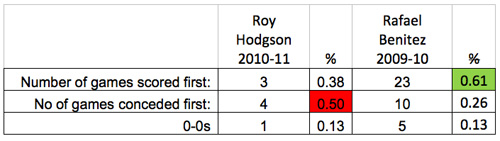
What we can see from the above figures is that Liverpool are scoring first less, and conceding first more. Not a good way to evolve. As it’s fair to say that Roy has been dealt some of the more difficult matches he’ll have to face during the first eight games, I thought I’d also compare his stats with the corresponding fixtures from last season. [Although, on paper, with two home games against promoted teams, the balance is actually fairly equal in terms of overall opposition quality.]
I have had to replace Blackpool with Burnley (previous season’s play-off winners) and West Brom with Birmingham (promoted as 2nd in the Championship) for Rafa’s figures.
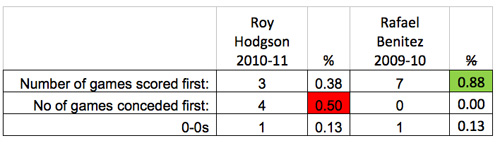
I have to point out that in two of the seven games where Liverpool scored first last season (Arsenal home, Manchester United away) the Reds lost the match, so scoring first isn’t the be all and end all when it comes to getting results.
But it doesn’t half help most of the time.
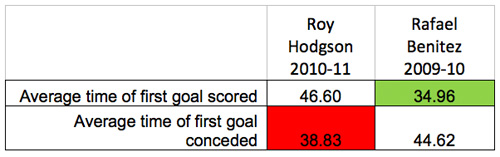
I’ve also broken it down into an average timing for each. This table includes the whole season of 2009-10 for Rafa:
This is for the ‘matching’ eight fixture that Roy has had:
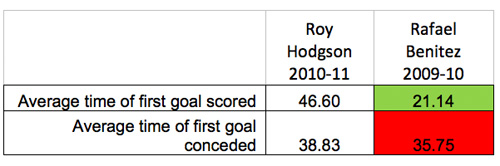
From eight league games so far this season, Liverpool have mustered just one solitary first half goal. If you asked Steve Bruce (and we won’t), they wouldn’t even have that, as it was the controversial first goal against Sunderland. By comparison, Rafa’s Liverpool scored eight first half goals in the exact same fixtures, and in two games (Sunderland and Burnley at home) they had scored two by half time; a long way towards securing the points.
Add to this that there have been five first half goals conceded so far this season, and only two clean sheets overall, and it becomes apparent that Liverpool have big problems at the moment defensively too. Liverpool’s percentage of league clean sheets is currently 25%; Rafa managed 45% for the whole of last year, and 50% for the same eight games as Roy has faced so far.
Regular readers will know I keep a record of substitution timings after researching an article for this site earlier this year. But I’ve devised another stat since then – time of the first substitution when the match is 0-0.
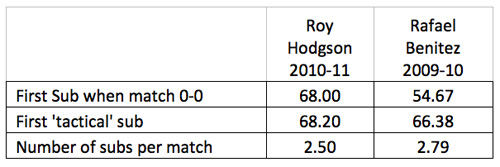
Everyone (without any access to any actual statistical research) knows that Rafa never made a change before 65 minutes in a match. Well, last season he tried a change when the match was 0-0 after 54.67 minutes on average.
Media favourite Roy Hodgson, on the other hand, hasn’t intervened until 68 minutes have passed in matches that are deadlocked and goalless, though in fairness this has been only two games so far. (Perhaps more worryingly, changes when the Reds have been losing have also been left late.)
He also makes fewer changes, and makes his first ‘tactical’ (e.g. not including forced substitutions due to injury that occur in the first half of matches) slightly later on average. This seems to back up what one poster on this site had heard from a Fulham fan friend of his – with Roy, it’s Plan A all the way.
This isn’t intended to be a fish-shooting-in-a-barrel exercise, and I desperately want Roy to do well, because it will mean Liverpool are doing well. But knowing that people who read this site are interested in statistics and how they often disprove perceived media wisdom, I thought I had to share what I had found.
In many ways you can make what you like out of these stats, as they’re based on small samples, and Rafa probably had certain advantages over Roy (e.g. the fact he had more of his own players in the squad and they were more accustomed to his tactical plans etc), but the one statistic that matters most is this – results from the comparative eight league games:
Rafa – Won 3, Drawn 3, Lost 2, For 14, Against 7, Points 12.
Roy – Won 1, Drawn 3, Lost 4, For 7, Against 13, Points 6.
Grim reading indeed.
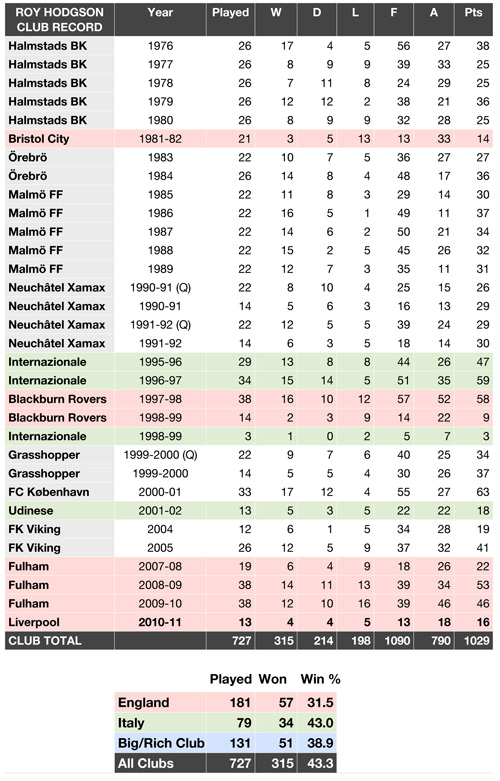
Roy’s Hodgson’s Managerial Record
Below is a full record of Roy Hodgson’s managerial career at club level, based on league results only.
What’s noticeable is that it took him 12 years to manage a club for more than 26 league games; mostly due to smaller Scandinavian leagues, and also due to only lasting 21 games at Bristol City.
In England he has managed for 181 games, winning just 57 – at 31.5%. Liverpool should be aiming for 50-60%, with 60% necessary for the top four and 66%+ for the title.
In Italy, he managed for 79 league games, winning 34, at 43%.
In England and Italy, at clubs who were big and/or rich (therefore excluding Bristol City, Udinese and Fulham), his record is well below average. Winning just 51 out of 131 games with these clubs gives him a worse win% than Graeme Souness had at Liverpool; yes, that bad.
Even including all his successes in small Nordic leagues, Hodgson’s entire career win rate of 43.3% suggests a manager who just isn’t ambitious enough in his approach. He’ll make smaller teams hard to beat, but he won’t make bigger teams become winners. Hodgson was the right man for Fulham, but based on his record and performance to date, the wrong one for Liverpool.
Key: Red shade = England an green shade = Italy.
Crisis Part 3: Flawed Transfer Policy
At Fulham, Roy Hodgson had a lot of success reviving the fading fortunes of players like Damien Duff, Danny Murphy and Aaron Hughes. Buying someone like Duff was a masterstroke for such a club.
But what he’s trying to do at Liverpool reminds me a little of how Souness tried to transfer his success at Rangers to Anfield; albeit in a different way.
Souness took good English-league players to Ibrox (Terry Butcher, Trevor Steven, Gary Stevens), and it worked wonders.
But when he tried to reverse that (Mark Walters, Istvan Kozma), it was a disaster – because he was buying players who were excelling in an easier environment. Once they were put up against better players, their confidence dropped, and their relative lack of ability exposed.
Now, if Roy’s aim was repeat his Fulham trick with Christian Poulsen – an ageing, fading force – then there’s a big snag. Players like Poulsen and Duff often need to rehabilitate out of the spotlight. Duff had fallen away a bit after a great start at Chelsea, and flopped at Newcastle. Therefore, Fulham was a lower pressure environment. And no-one was expecting much from him. He was now a big fish in a small pond, rather than vice versa.
While you can never rule it out, it’s far, far harder to find lost form at a club like Liverpool. Because every mistake is magnified; every awful display is a weight around the neck for the next game. Careers tend to be revived by dropping a level – either in expectation, or to a less-intense league. You don’t often revive your fading fortunes at a club like Liverpool or Manchester United. It’s too much pressure.
Poulsen has ‘extra-big-club’ experience at Juventus; unfortunately, he was not a success there, so you cannot say that he had proved he could cope in the spotlight. So while I can see some of the logic – he was once a good player – he also looks painfully slow, and the Premier League is unforgiving to those who lack pace (unless you’re as gifted as Xabi Alonso, and can always find time and space).
If you can pull it off, it often makes the most sense to buy a player with problems (the Nottingham Forest approach outlined in Soccernomics), but it’s easier said than done to revive a career.
(Of interest is that Forest built success on the back of rescuing players, but never maintained that success beyond the initial burst; although of course, winning the league title and back-to-back European Cups is nigh-on impossible for such a club to maintain. But it worked when Forest were an unfashionable side; once they were fashionable, it stopped.)
Another problem is if the player is at the wrong end of his career; ‘let them lose their legs on someone else’s pitch’ was Bob Paisley’s motto.
Back then, of course, Liverpool were not desperately scrabbling around for bargains. At times, Benítez and Hodgson have been forced into such moves, because of debt placed on the club.
However, look at many of Bill Shankly’s best signings and they were in their early-to-mid-20s. Paisley often did the same. So did Benítez. (And though not monumental fees, there are reasons to believe Poulsen and Konchesky were overpriced; more on that later.)
Maybe it’s similar with Joe Cole, although unlike Poulsen, you’d think he has enough about him to be marginally effective at worst, and at best, rediscover the promise that marked him out as a real prodigy.
I think we know that Cole is used to pressure, and despite massive wages, the lack of a transfer fee made it a gamble worth taking. But he’s another player who was picked up at a time when his confidence wasn’t sky-high. If you can reinstate it, great. If you can’t, you just get more of the same. So far, bar the odd flash of brilliance, Cole has been on the edge of games, whether on the wing or in the hole.
And unlike Poulsen, at least Paul Konchesky was not in a career trough, but again, at 29, has limited shelf-life for a fee of almost £5m. The problem in his case is one of adjusting to life at a big club. Used to the league? Tick. Used to the manager’s ideas? Tick. But of the necessary quality and experience? Undetermined. Lee Dixon isn’t convinced.
In fairness to Roy, it’s natural for managers to go back for players they’ve worked with before, or to plunder leagues they’re familiar with. But that’s more of a problem when the clubs they managed were so good.
Noted scout and football analyst Tor-Kristian Karlsen (the man who brought Lucio, amongst others, to Europe) shares my concerns.
He feels that Hodgson – who managed in Karlsen’s native Scandinavia for many seasons – has a narrow outlook to scouting, and that his style of management is more suited to smaller clubs or lower-pressure leagues. He also worries that he’s more likely to scout the weaker north European countries.
Now, I have never denied that Rafa’s struggles last season were partly down to his recent purchases, but he spent money trying to introduce flair to the side, especially at full-back (for a more progressive approach).
Also, the fact that Aquilani was hunted by Juventus – for whom he’s shining – shows that this was a pedigree player rather than a chimera; for me, one to stick with while adapting, like Pires, than consistently fail to deliver, like Cheyrou. He may not have been 100% suited to English football, but he showed real creativity in the second half of last season, once finally fit.
Age Concern
I have to hark back to a point I made in August: the age of the players being sought, and how, as with tactics, it strikes me as a backwards step.
The greatest thing about Benítez’s legacy was how many talented purchases were still relatively young: Reina, Torres, Agger, Mascherano, Johnson and Skrtel.
I made the point a while ago that the problem with what Benítez inherited from Houllier was that Hyypia, Hamann, Babbel and Henchoz were all 30/31. So his good players had little shelf-life, and little sell-on value to revamp the squad.
Houllier also left players like Cissé (who cost £25m in today’s money), and the likes of Cheyrou, Diouf and Diao. So his successful older purchases were too old to either cash in or rely on for more than a couple of years, and his younger ones were horrendously over-priced and just not good enough. Cheyrou and Diao were given away in the end, having cost around £20m in today’s money.
Not that Benítez didn’t have his flops; but resale value was always crucial. He understood it. Flops came and went, but they raised the money that bought the successes. And until the money dried up (as much as £15m recouped on Robbie Keane, none of it seen by a Liverpool manager), he was able to constantly upgrade: Sissoko to Mascherano, Bellamy to Torres, Josemi to Arbeloa.
He may not have always got the players right (few managers do better than 50%), but the policy was sound.
I said at the time that Benítez overspent on Keane, even though he was proven in the Premier League.
Even so, £5m for Poulsen seems even more foolish. Much of the Keane money was recouped (and even more will be if Keane remains at Spurs). Poulsen will lose the club a greater percentage of his fee.

I fear the same applies to Konchesky, at 29, who is valued the same as Insua; in two years’ time, Insua will be a more experienced player, and still young, at 23. He’ll surely be worth at least what he is now. Konchesky will be 31, and worth next-to-nothing.
Over the course of Premier League history, prices for a player aged 29 and 30 are 40 per cent lower than one aged 28. (Source: our TPI research.)
However, as with a new car whose value depreciates once driven off the forecourt, the value drops rapidly; the average for a 31-year-old is less than half that of a man 12 months younger. By 32 you’re almost giving them away. Poulsen will turn 31 this winter.
Compare him with the Greek.
Kyrgiakos (£1.5m) scared the life out of me in some of his early displays, but it didn’t take long to look a decent back-up, and in truth, put in some excellent displays last season. It’s typically crass to include him as a prime example of the ‘dross’ Rafa left, because he was cheap and not a household name. For his age, £1.5m was a sensible price. £5m would have been crazy.
The idea that Kyrgiakos and Ngog were mistakes in a rubbish squad makes little sense, when one is adequate back-up and the other is clearly an up-and-coming talent. You can add the £1m paid for Insua to those two and still get Poulsen’s fee, and have three players with an average age of 24, instead of one almost 31. So it’s not like Roy has no part to play in the bad start to the season.
Why Overhauling Is Dangerous
Regular readers will also know my theory that, by and large, you have to buy four players to land two good ones. Obviously this is a law of averages thing, but since the remarkable 1987 it’s hard to think of a calendar year where a Liverpool manager got close to a 100% success rate. Indeed, the same applies to all managers. This is why rebuilding a squad in dramatic fashion can often be catastrophic; you have to make sure you’re not easily letting go talent, because you will probably regret it.
Hodgson came in, and immediately put four of his own players into the outfield ten.
Some signings will flop, and some will succeed. Having looked at the records of men like Benítez, Wenger and Ferguson, a 50-50 split seems about right.
The successes will vary in the level of their brilliance, and the flops will range from mediocre to awful, but if you had to say ‘good buy’ or ‘bad buy’, you’d probably find as many going into each category. (And while expensive players flop, what paying extra gives you, instead of a guarantee, is an increased likelihood of making a big impact.)
Like Souness, I seems that Roy has tried to do too much too soon to the first XI, and bought in the wrong manner. Raul Meireles looks like he could prove to be a class act; but too many question marks remain about the fitness of Fabio Aurelio, the ‘has he still got it?’ of Cole, and the quality of Konchesky, Poulsen and Brad Jones. None of these players has a long shelf-life. It was quick-fix spending, and it has resulted in only further breaking things. It’s early days, but none of Roy’s signings has time on his side. At the moment, neither does he.
Liverpool are now without Mascherano, Benayoun, Aquilani and Insua; not all Roy’s fault, certainly, but the replacements have not proved to be as good, and have contributed to the worst start in living memory. Benítez left those players; but Roy couldn’t convince Mascherano and Benayoun to stay, and opted to not have Insua and Aquilani as part of his squad.
Not only have Roy’s tactics not worked, but his own signings have added little. Compare and contrast to the impact made by Alonso and Garcia, two players totally new to English football in 2004, under a foreign manager who supposedly didn’t understand English football. Rafa had the right idea, but sometimes bought the wrong players. I’m yet to be convinced that Roy has the right idea.
Crisis Part 2: Homesickness
Source
I knew my time was up on the official Liverpool site when they chose to run this Paul Hayward piece not in the Media section, but as an editorial. As much as I like the people who run the site – honest, intelligent people doing their job (as requested) – I was depressed at how such nonsense could be legitimised. It went against everything I’d spent so long arguing in favour of. By that stage I was finding it hard to recognise the club I’d happy to been associated with since 2005, but less comfortably since 2007.
“By the end of the Rafael Benítez reign one of the game’s great clubs had adopted a kind of mechanical pragmatism designed to destroy the opposition’s plans rather than impose their own.”
“Anfield’s regulars were suffering but were too loyal to complain. They filed out through the Shankly Gates bored. It was inimical to Liverpool’s followers to see their heroes win games by calculation alone. They revered Benítez for the 2005 Champions League win in Istanbul but could recognise the creeping joylessness of his football and his apparent inability to derive any pleasure from a goal.”
“Hodgson’s Liverpool will get back on the front foot. They will assert their pedigree. Nullifying the opposition will not be their religion. This is the first step out of the darkness for a side who finished seventh in the Premier League and now face a second Europa League campaign.”
Because, the day before, I’d written this piece pulling it apart. The Guardian is my favourite paper (I worked on the marketing side of things for the paper in the ’90s), and has some great football writers. But few writers get as much wrong about Liverpool as Paul Hayward.
Not only was the criticism of Benítez unnecessary to include on the official site, but the piece had no basis in reality. Hodgson and attacking football? – as well as he’d done in certain jobs, going on the front foot was never part of it. Go check the amount of goals his teams scored, and the many, many draws they would rack up (the story of his time at Inter Milan, too.)
Too many bored fans filing out through the Shankly Gates? – were we now forgetting the four Champions League quarter-finals in five seasons; three semis in four; two finals in three? Or the two best league seasons in terms of points won in 20 years? Last season was fairly grim, but Hayward’s piece was bunkum.
Liverpool averaged 1.7 points a game last season. So far this season, it’s 0.8. Progress? Is one win in eight really going on the front foot? A bit of research and Hayward might have seen the likelihood of this coming; I certainly did.
Take a look at this graphic from the Daily Mail, after Liverpool’s first seven games this season. Which manager’s stats suggests ‘mechanical pragmatism’?
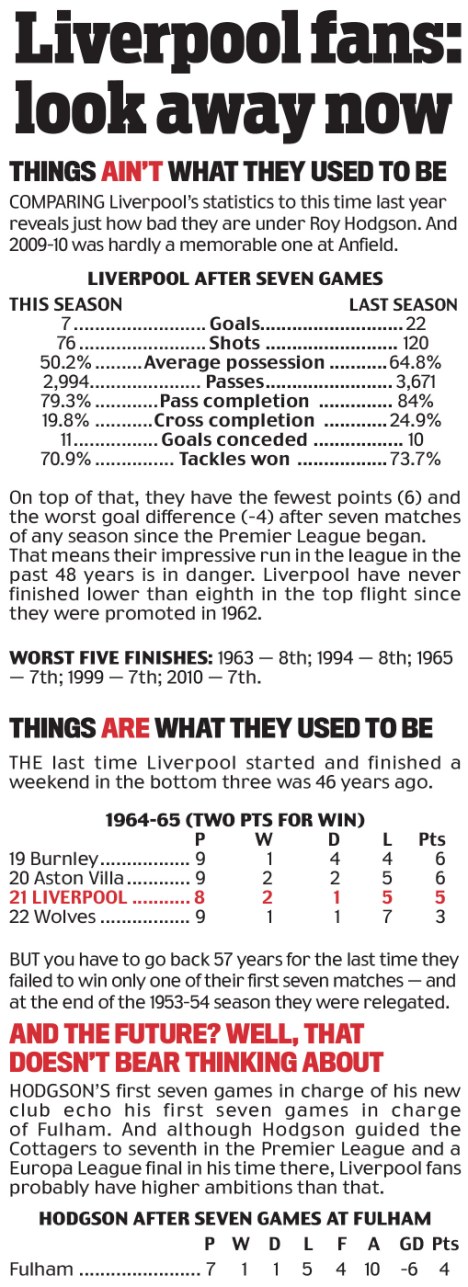
Add the Everton game to that graphic, and it only gets worse.
Home Comfort
It always baffled me that a major criticism of Liverpool under Benítez was a failure to break down teams at home. His side never won fewer than 12 league games at Anfield each season, and overall averaged 13 wins out of 19.
In total, only nine home games were lost under Rafa: 1.5 a season. In his middle four years, only three were lost in total.
Now I hear Danny Murphy (who’s not bitter) saying that the English heart was ripped out and replaced with a Spanish core – as if that’s a bad thing these days! Well, now the English are back. How’s it working out?
What was this English core that was torn out in 2004? And presumably, things were much better then?
Well, the Reds won an average of 10.8 games per season at Anfield under Houllier; more than two fewer each year than under his successor. In his final two seasons, Houllier’s team won just 9 and 10 respectively. (Compared to 12 and 13 in Benítez’s final two.)
Under Evans it was 12.5 wins per season at Anfield; better than Houllier, worse than Benítez (one of Evans’ seasons had 21 home games, not 19).
But it’s the losses that jump out: 11 in four seasons under Evans, 2.75 per season. With Houllier it jumps to 3.1 home defeats each year, more than twice as many as under Benítez.
Surprisingly, Liverpool actually won a good number of home league games under Souness (13 in each of his two full seasons), but lost 3.5 on average (3 and 4). And of course, these were 21-game seasons at Anfield, so again, it’s worse than Benítez’s record.
Indeed, the Spaniard’s win-rate at home was more-or-less identical to that of Kenny Dalglish when allowing for the extra games.
Liverpool’s record away from Anfield has been patchy ever since Dalglish left, with a pathetic three victories in each of Souness’ first two seasons (21 games). That was what caused the great collapse.
It’s perhaps to be expected to hear Mark Lawrenson say that the side Benítez left was worse than the Souness era, but as ever with Lawro, it doesn’t hold up to scrutiny. (Let’s also remember that Liverpool had the most expensive squad in the country under Souness. Last season, Liverpool’s squad didn’t even cost 50% of any of three of the squads of teams that finished above them.)
Since Souness’ days the record for away wins has dropped as low as five under each manager (most with 19 games played, not 21), including last year: Liverpool’s clear problem in 2009/10.
By contrast, the number of away wins has only gone into double figures on three occasions: 12 in 2001/02 under Houllier/Thompson; 10 in 2005/06 under Benítez; and a club-record 13 in 2008/09, also under the Spaniard. (To compare, in the ‘80s it was mostly between 8-10 away wins a season, often with 21 away games.)
What does all this prove? Well, I’m not sure.
But one thing that seems apparent to me – as has done since his appointment – is that Roy Hodgson sets up in a very similar style to Gérard Houllier: the man with the worst home record in Liverpool’s recent history, and the only manager since the days before Bill Shankly to win less than ten home games in a season (2002/03; before that, it was 1954/55).
The point, you ask? Well, so far this season Liverpool have played four games at Anfield, three of which were home-bankers (and the other, Arsenal, was a home win more often than not under Benítez.) Now, even home-bankers turn into draws sometimes; but on the whole, you’ll win them most times.
The result from these four games? One win, two draws and a defeat. Early days, yes. But a 25% win ratio, even at this stage, is hugely concerning. Under Benítez, the average was 72% of home league matches won, rising as high as 83% one season, and dipping no lower than 67%.
With Liverpool’s away form so poor, and Hodgson having only won a couple of away league games in two-and-a-quarter seasons, home form is vital.
A lot was made of the tough start Liverpool had, and to a degree that was true; Arsenal, Man City and Man United were definite tough ones. But after eight games – four at home, four away – and having also faced West Brom, Sunderland, Birmingham and Blackpool, six points is a terrible return.
Four games may not be a statistically significant sample, but this article does show that abject home form was definitely not something Roy Hodgson inherited. Losing to a promoted side for the first time since the days of Houllier is also concerning.
In the terrible season that everyone labelled 2009/10 (and it was pretty grim), only Arsenal, Chelsea and Aston Villa – top sides – left Anfield with the full spoils.
This year, Blackpool have not only won, but won by dominating the Reds; unthinkable, even during the poor spells of the past six years. Sunderland, thrashed 3-0 last season (and it was a thrashing; even Steve Bruce said so), were unfortunate to only draw 2-2 this time.
Has that much changed in terms of the quality of the squad in a few months? And if it has – with three or four of the XI each week Roy’s own signings – should that still be blamed on Rafa?
One player Roy has lost is Mascherano; but “he’s not needed at home”, people said. But of course, his reading of the game, pace and tackling allowed the full-backs more freedom, and thus the pitch could be opened up. But even so, you’d still think his main benefit was against teams that needed stopping, not ones that were there to be beaten.
So Liverpool need more English pride, and must move away from calculating football? Sorry, but that stacks up as xenophobic bullshit, wrapped in bitterness.
Crisis Part 1: Hypocricy and Hodgson
Source
Apparently I’m a hypocrite, because I had faith in Rafa Benítez, but struggle to find it with Roy Hodgson. So, what is different from previous seasons? And am I wrong to have a different attitude to the respective managers?
Believe me, I’d rather be talking about a new, successful Liverpool manager, but everywhere I turn I hear Benítez’s name being assigned to the rapid decline of the club, and Roy being excused his own shortcomings.
I wrote this piece in reply to all those who continue to blame Rafa for the financial woes, including a leveraged-buyout chancer. But Tom Hicks isn’t the only one blaming Rafa.
The other week Clive Tyldsley said that Liverpool didn’t even really win either of the trophies Rafa is credited with, because both games were only drawn after extra-time. Ergo, Rafa wasn’t that good after all. (I’m looking forward to seeing the United-supporting Tyldsley tell Ferguson that his second European Cup is null and void.)
Howard Wilkinson recently said that Torres was burnt out by Benítez: “He was always playing, Benitez just wouldn’t leave him out.”
(Yes, Howard – that’s why there was never uproar on those occasions when he did rest him, or the many occasions where he’d take him off after 70 minutes to protect his muscles, or the occasions he was only a sub when returning from injury; and also ignoring that most of the injuries tended to occur on international duty, too. I really must get a toke on Wilko’s crack pipe.)
Harry Redknapp came out in sympathy for Gillett and Hicks, wondering what they’d done wrong. (Thankfully, David Prentice at the Echo answered that one.) No offence Harry, but why not talk about the clubs you left that subsequently went into administration?
Add to these countless TV and newspaper opinions blurting out, one after another, that “it’s all Rafa’s fault”, like squealing schoolchildren trying to pin the blame on anyone who might be a sucker for a caning. Blame the foreign kid. It’s what bullies do.
While Rafa took some deserved criticism at times last season, I felt he’d copped his fair share (if not more), and that it would end when he was dismissed from his duties.
But no, it seems he has to cop for the shortcomings of Roy Hodgson too, and more alarmingly, the horrendous mismanagement of the club higher up. Every last thing has been blamed on the Spaniard. I came to accept that the time was probably right for Rafa to move on, given the politics at the club, but I was never convinced that Roy Hodgson was the man to replace him.
It’s not about wanting Rafa back, but moving on in the right way, not the wrong way.
Hypocrisy
The reaction to this recent piece was interesting to note. Roughly a third thought it was bang-on the money; a further third thought I had gone too easy on Roy, and that he was a waste of space who had to go; while the remaining third were up outraged at my ‘hypocrisy’ – up in arms like Mary Whitehouse rewinding and re-watching a Peter North video, just to get annoyed all over again.
This is the lot of the football writer. Sometimes I can say something on Twitter and get abuse from people who think I only say blindly positive things, and replies from those who call me a hypocrite for treating Roy 100% differently to Rafa – all in reply to the same original comment.
Perhaps I am a hypocrite; we all inadvertently contradict ourselves from time to time.
It seems that those who spend their time ranting about what I say have got their knickers in a twist because I haven’t defended Roy to the extent I defended Rafa. Well, aside from one or two changes of opinion (which we are allowed to have, so long as we don’t change back and forth on a whim), there are some valid reasons for this.
First, people compare my current blogging to my work I used to produce for the official Liverpool site. People who can’t distinguish between the difference required in approach and tone are not intelligent enough to debate with.
(I recall with great humour one angry person saying something last year, along the lines of “if Rafa was replaced by Guus Hiddink, that Tomkins would be saying that the new man’s a world-class manager and defending him to the hilt”. I remember laughing, thinking that of course I’d defend a world-class manager! If the person had said Steve Bruce, I would have taken exception. In many ways, he proved my point. You defend those who are the best around, and have concerns about those who are not.)
Regular readers will know that, contrary to popular belief, I made criticisms of Rafa on my blog, and in my books, and even to him directly. But of course my overall stance was one of positivity, because I understood his thinking and, on the whole, believed in his methods.
And this comes back to another problem with Roy, which is one that the Kop as a whole seems to be struggling with.
When Gérard Houllier was appointed, he arrived with a strong reputation; associated (not that he was slow to tell us) with France’s World Cup success. For a few years, it seemed merited. To me, his appointment made sense, and he was what was needed at the time, even if I came to hate his tactics in later years.
When Rafa arrived, he’d just won two La Liga titles in three seasons, plus the Uefa Cup. (Someone tried to tell me the other week that he ‘left a shambles at Valencia’; in his final season they won a league and cup double. Some shambles. The shambles, as the players who wanted him out later admitted, only happened once he left, because he was not there anymore.)
Along with José Mourinho, Rafa was the hot ticket in 2004; but it was achieved at the sharp end of football. This was a man taking on Barcelona and Real Madrid with a smaller club (but not a tiny club, and not a small-club mentality), and winning league titles.
By contrast, when Roy arrived, his team had just finished 12th, and scored only 39 league goals. They had a great run in the Uefa Cup – but cup runs involve a greater element of luck than a league season. Steve McLaren took Boro to the same final, but as unfairly mocked as he is, he was patently out of his depth under that England umbrella. Not a bad manager; just not the right manager. (Rafa also enjoyed cup success, but he averaged 72 points a season in his six years, seven more than the man he replaced: overall, progress.)
And this brings me back to my problem with the appointment of Roy in the first place: namely that my research – and it’s a lot of research – shows virtually no success stories when it comes to ‘promoting’ managers who’ve done well at small clubs to the really big jobs.
Now, each case must be judged on its own merits, because someone can always prove the exception; but the trend is clear. There is an entire chapter dedicated to this phenomenon in Pay As You Play. (Around the time of its release I will make that the one free sample for people to read, to show what I’m talking about.)
Now, I don’t know if sacking Roy or keeping Roy is the answer. Amid myriad concerns, I cannot state either way with any certainty. I thought he was the wrong man in the summer, but it’s not as easy to find the right manager in October.
I do know, however, that the football has been universally dire, and that even though it’s ‘just’ eight games, the league position is shocking.
I do know, however, that none of my doubts about appointing him have been assuaged. (These doubts were not part of any agenda; I made my feelings known before he was appointed, saying that he was in no way a bad manager, just one who seemed unsuited to this particular job. Having said that, I did at least expect a honeymoon period before talk of a divorce. I also expected a positive ‘bounce’ after NESV’s takeover.)
I’ve also made it clear that the squad has been worn away by too many sales, and that this is not necessarily Roy or Rafa’s fault. I’ve been at pains to say how difficult the job was with the pressure and expectations, and those god-awful owners. Indeed, call me a hypocrite all you want, but unlike those now leaping on the bandwagon, I’ve been saying this for three years, ever since Gillett and Hicks showed their true colours with ‘Klinsmangate’.
Whatever the travails, and whatever the holes in the squad, this is a team that is woefully underperforming given the talent that remains.
Rafa was sacked, according to the club, for football reasons. I was told, time and time again by Rafa’s critics, in emails, Tweets, etc, and indirectly via the media, that 7th wasn’t good enough; that 7th was the result of him mistreating players and not having the passion to succeed. The squad was too good to be 7th, and so on.
Even last season’s run to Rafa’s 4th European semi-final in six seasons (with the two semis that were lost only being resolved in extra-time) wasn’t good enough; and while I felt Rafa was harshly treated, I did not make the argument that the Europa ‘success’ was a big deal.
Because, let’s face it, it really didn’t feel like a big deal (and nor does our European form this season). Last season, that cup run was a mild distraction from a difficult league campaign. A cup semi was of little consolation.
People keep reminding me that we were as dire at Portsmouth and Wolves last season as we’ve been this season. That’s hard to argue with. But those were low points from the season; they came before and after some excellent displays – even if there weren’t as many excellent displays as in previous seasons. They weren’t happening every single week.
The trouble this season is the lack of even one decent league performance. The second-half against Arsenal was full of character, but that aside, the football has been terrible.
Last year, Liverpool were rubbish perhaps 30% of the time; this season, it’s arguably been 100% of the time. And for the life of me I can’t recall Liverpool being totally outplayed, and beaten, by a promoted side at Anfield since the Houllier days. Or failing to even contest a derby under Rafa Benítez, whose record against Everton was superb.
Liverpool went 2-0 down to Hull a couple of seasons back, but a draw was quickly rescued, and it could have been 5-2 to the Reds by half-time. Some face was saved. There were tactics used that day that were beyond sending the big lump up front.
When both Houllier and Benítez arrived, there were quickly signs of progress. There were also setbacks. But this season has been setback after setback on the pitch. Not all are Roy’s fault. Some are. And as manager, he’s responsible for getting performances out of 20 international footballers.
Let’s remember that I have always maintained that two consecutively poor seasons are what I consider failure for an established manager; this is in my first book, from 2005. Houllier left a team that won just 16 out of 38 league games in his final season – two fewer than last season – and racked up 60 points, three more than the team Houllier left had managed.
One key difference last season was the emergence of stronger rivals. And the other difference was that just a season earlier, Liverpool had won 86 points; in the penultimate year for Houllier was just 65.
Crisis
When Rafa arrived in 2004, the squad cost more (in current money) than it did last season. Houllier left a worse collection of players – and ones who had cost more money (£25m in current terms for Cissé just one example).
Rafa was new to English football, new to England, and new to the English language.
He needed time to settle in.
When the Reds lost in the FA Cup, he was accused of not understanding English football. And at times, in some away games, to some degree it showed.
But there were still some great results, and stunning performances. I was awestruck at Anfield in a 3-0 demolition of Norwich thanks to this new playmaker called Xabi Alonso and a mercurial talent named Luis Garcia.
In mid-January 2005 Liverpool were in crisis. Similar kind of stuff to now: Radio Five Live ‘crisis’ debate, and so on. The Reds had lost away at Championship Burnley, 1-0, in the FA Cup. Go and find the old newspapers; it was a sensation.
Of course, the Reds, under this new foreign manager, were still 5th in the league at the time, and in the knockout stages of the Champions League; an improvement on the club’s previous showing, in 2002/03.
And the Reds were also in the Carling Cup semi-final. Yes, it was further into the season (23 games), but let’s observe the radical difference in levels there. Rafa was taken apart for a far better start than this. And no-one was saying “yeah, but he was left a weak squad”. It was all pinned on him.
I never had to defend Rafa winning only one of the first eight league games, or being 19th at this – or any – stage of a season. I never had to defend Rafa going out of a cup at home to a team more than one division below, let alone three. So how does that make me a hypocrite? I’d only be a hypocrite if I criticised Roy for the same kind of start I excused in Rafa’s case. This, clearly, is far worse.
Roy has had problems and pressure to deal with; then again, a lot of this stuff isn’t new.
Before the Champions League game away at Marseilles in late 2007, Rafa needed to win to save his job; he was going to be replaced with Jurgen Klinsmann, who’d been sought behind the manager’s back – just months after the second Champions League Final in three seasons.
That’s pressure, too. The Reds won 4-0, taking the French team apart on their own soil. Time and time again he was crucified by the media, and almost every time the Reds turned things around on the pitch. Rafa had at least as much negative press last season as Roy has had this, if not far more – all at points when things were a lot better than they now are.
But there’s also a key distinction between a manager who has proved that he can punch above his weight at the top end of a major league and in Europe’s premier competition for this club (as Rafa did on a number of seasons), and one who has no prior record of success in this particular job to refer back to.
My support for Rafa became almost unequivocal in Istanbul, although I saw signs of progress that whole season (such as coming back from a half-time deficit for the first time in five years, first against Manchester City, in the opening home game, then to win 4-2 at Fulham from 2-0 down, despite being down to ten men; followed in November by deservedly beating reigning ‘Invincible’ Champions Arsenal 2-1 at Anfield).
But I wasn’t 100% convinced until he worked that particular miracle; and even then, I never felt convinced that we’d get close to winning the league (it seemed a million miles away in 2004).
He then followed it with the club’s best two points tallies since the ‘80s. But now all we hear is that there was a total lack of progress under Benítez? Well, the ride dipped at the end; but let’s not ignore five years of soaring.
As was pointed out to me by Fulham writer Richard Allen, their fans, and their players, had their miracle with Roy when escaping relegation on the final day of the season, coming back Istanbul-style to score three vital goals at Manchester City. That gave the club belief.
But that doesn’t necessarily transfer to Liverpool, does it? That’s Fulham’s miracle, not ours. (And it only really relates to us if we remain down there until May, heaven forbid; or if a different kind of miracle is pulled off.)
Instead, so far it’s been the reverse of a miracle: a nightmare.
And instead of Roy getting his share of criticism from the majority of media outlets, it’s Rafa who continues to get a pummelling.
That bothers me, because Rafa had his share of the blame last season. He was also sacked with the statement that the club needs to get right back into the top four, “where it belongs”. My view was always that top six is more realistic. Neither looks remotely possible right now; the football needs to improve a hell of a lot first.
Hypocrite or not, I enjoyed Rafa’s style of football (although at times last season it was poor). Like any team, Liverpool could have struggles, but top scoring in the Premier League just two seasons ago was no mean feat, given that the squad was not within touching distance of the cost of the clubs the Reds were competing with (and that Torres missed half the season). Yes, it could be tactical, and sometimes even dour, but on the whole it was exciting more often than not.
But it’s harder for me now, as I have a personal dislike of the Allen Wade style of football beloved of men like Hodgson, Houllier and Eriksson. If it’s working, it’s fine; but when it doesn’t, it offers little redemption as a spectacle, and provides opponents with the chance to dominate possession and boss games. I understand the benefits of the system, but I’m not sure I get how it’s meant to work at Liverpool in 2010, particularly at home to lesser teams.
I accept that a side can’t be chock-full of skilful players; you need your grafters, and they were there over the past six seasons, too. But for me, a shift from players like Aquilani, Agger, Insua and Babel – even if they weren’t always used – to Konchesky, Skrtel, Poulsen and the promising Meireles – leaves less creativity overall. (Cole should replace Benayoun fairly equally, though has yet to match the Israeli’s output.)
Surely that’s clear? Even worse, the Reds aren’t even defending as well, despite the more destructive balance to the side. It’s not working in any single area, and that’s my concern. If we were grinding out results, fine; but we’re just grinding our way to limp defeats.
Roy had a team at Blackburn that won only one of the first 14 games of 1998/99; he was sacked with them 20th. They revived a fraction after he went, but not enough – relegated in 19th, where the Reds currently sit.
That was the most expensive team to be relegated in the Premier League era (source: Pay As You Play). The team was the 5th-most expensive in the division that year – roughly the same as this Liverpool side. Food for thought?
The real hypocrite?
If you want to talk about hypocrites, how about Henry Winter? This time last year, Liverpool were suffering a poor start – but nowhere near as poor as this. The Reds were 3rd after seven games, 5th after eight games, 8th after nine games, 5th after 10 games. After seven games the Reds were just three points off the top; after 7 games this season it was 12 points. (Currently it’s 13.)
And yet this autumn, Tony Pulis – perhaps because he’s not a foreigner – was lauded by the same journalist for making the very same decision; Pulis was showing his commitment to Stoke, Benítez was cold and uncaring.
None of this is to say that Benítez’s inter-personal skills weren’t at times lacking. Sometimes they were. But isn’t that a bit of a cruel comparison?
Before the latest defeat against Everton, Winter was saying that the “hounds” have been unleashed on Roy; unfair for such a new manager, he says.
He might have a point on whether it’s too early to criticise to such a degree (though the relegation zone is a new experience for LFC fans), but surely it’s at least as bad to do so when the manager has previously won you the European Cup and, only months earlier, overseen the best league season in the club’s recent history?
That’s every bit as premature as this, if not far more premature. At least Rafa had shown he could win trophies for Liverpool and take a title race down to the wire in May.
However critical I am of Roy, getting personal like Winter did there is a low blow I would never dare strike. Bringing a reaction the death of a manager’s loved one into your football criticism? For me, that’s a red card offence.
Time Is Up?
I have always preached that managers deserve time. But there comes a point when you start to wonder if keeping him will only cause more problems. If he wasn’t right to start with, will time change that?
My views remain unchanged, in that I won’t call for Roy Hodgson to be dismissed; but he has to prove that he can adapt to life at a club like Liverpool, or face the consequences. And with every passing non-performance and a failure to win, he is eating away at whatever time he has left. At 63 he was never going to be a long-term appointment, but right now, Christmas seems a million months away.
Subscribe to:
Posts (Atom)
Popular Posts
-
Link It was early in the morning and Anfield stood empty except for one man. Kenny Dalglish had arrived just after dawn, let himself in, hur...
-
Living the dream, the man who stood up to Mourinho The Times Matt Hughes Once a protégé of the Special One, Porto’s successful coach is now ...
-
Source By Daniel Geey. Daniel works as a solicitor for Field Fisher Waterhouse LLP and advises entities wishing to invest in the football in...
-
The Question: is 3-5-2 dead? In the latest instalment of our in-depth series, Jonathan Wilson tracks the rise and fall of a tactical survivo...
-
link by nicodemus I've have been sick and tired of hearig all this JM bashing and saying" hes a cocky twat" " he'll ...
-
 Introduction Welcome to Euro 2008 and welcome to this column. As you may already know, fortunately, my professional obligations don’t allow...
 -
Rafa Benitez’s Liverpool Machine July 16, 2010 By Joshua Askew A 7th place league finish and a group stage exit in the Champions League ende...
-
This article is composed of extracts from a very long article intitled: From Sacchi to Zeman, Capello and Lippi to arrive at Descartes and K...
-
Source Get stuck in, readers. Photograph: Peter Dazeley/Getty Images The year of the blog? Very possibly, especially with the current batch ...
-
STEVEN GERRARD EXCLUSIVE The trial changed me. It was frightening. I will never celebrate in a bar again - the Liverpool and England star a...