Exclusive: My secrets, by Fernando Torres
Published 23:36 13/09/09 By James Fletcher
Penny Lane must have seemed a million miles away from Madrid to the young Spanish schoolboy.
So too, the ‘Yellow Submarine’ that Fernando Torres sang about with his brother as they recited Beatles hits passed down from their father Jose.
Indeed, ‘El Nino’, would not even have known who the Fab Four were given his tender years or what it was they were singing about. But he loved their tunes all the same. And that was all that mattered.
Had anyone told him just how intricately linked he would ultimately become with Liverpool’s most famous sons and he would have laughed it off as madness. Liverpool? He’d never even heard of it. Yet the city was to become his second home. His future. The platform for his footballing dreams and the Beatles back catalogue was to become his Bible.
He said: “One of the biggest problems I faced when I first moved to Liverpool was the language barrier. My English was limited to the classes I had taken at school in Fuenlabrada. You think you know a bit of English and that you can get by but when you actually arrive in England you soon realise that you haven’t really got a clue.
“I was told to be honest and say; ‘I didn’t catch that, could you say it again?’ but the truth is I didn’t always take that advice. I nearly always just mumbled a ‘no’. That’s what I did whenever I was in the supermarket and was asked if I wanted ‘cash back’. It’s not something we have in Spain and I had no idea what it was. It was three months before I knew what they were talking about.
“One afternoon, the way back from having lunch we decided to go shopping. I’d been told about Costco and so we decided to go in and have a look. As we were going through the door, the security guard stopped. We assumed he was asking for a member’s card that we didn’t have and so, not be able to explain in English, we just turned and left without a word. The next day I was told if you’re not a member you can’t shop there.
“Two people were vital during my first few days in the city: Rob and Alan, the English teachers Liverpool laid on for me. One of the things they used to make me do was ring people in response to adverts in the paper. You’d get on the phone and ask about a puppy for sale, or that kitten being advertised, or the price of a second hand car.
“The idea was to get me used to speaking in English on the phone but at first the idea terrified me. So much so that I would panic when I didn’t understand something and find myself having to ring Pepe Reina.
“The car radio became my constant travelling companion. Every morning on my way to training at Melwood, I would listen and try to concentrate on what was being said. At first I only understood a few words but bit by bit I could feel myself improving. As I went past billboards I would try to translate them, too, and with every passing day I was getting better and better.
“Some nights, I even dared to pick up the phone and order food. When it turned up, it was nearly always what I wanted. When we were in hotels preparing for games I watched films in English with the subtitles on. The other thing I always carried with me was ‘English Training’ on my Nintendo DS - language games and exercises that helped me develop my English.
“I was terrified at the prospect of having to have a conversation on the phone. Imagine how much worse it is when that conversation is with the fire service! My smoke alarm kept going off in the house I was renting and one afternoon I got a call. I just about worked out that the man on the other end was from the local fire station but I didn’t understand anything else. A few minutes later a fire engine turned up at the house, packed with fireman thinking they were being called into action.
“They came three times in three days before they worked out that the smoke from cooking was causing the alarm to go off prematurely. The next time the alarm went off, they called me first to check whether they really did have to set off again.”
“I like the Beatles a lot. Before I ever imagined that I would end up in Liverpool, I listened to their songs. Now I’ve rediscovered them because listening to them has helped me to pick up the language more quickly. My favourite songs are ‘Penny Lane’ and ‘Yellow Submarine’.”
A giant 51-foot long, 15-foot high, 18 tons steel Yellow Submarine, replica built to commemorate the famous song, greeted Torres upon arrival at Liverpool’s John Lennon Airport.
Torres found himself immersed in Liverpool’s history, it’s culture, walking the famous streets, from Princess Dock to Victoria Street, taking time to enjoy Matthew Street and the Beatles tour, though he is still to visit the Cavern Club.
“What can I say about the legendary band, a symbol of the city? There’s not much I can add, although it did strike me that – despite what you might imagine – people in Liverpool aren’t constantly talking about the Beatles and their success,” he added.
“People have an enormous amount of respect and admiration for them, because everyone in London is conscious of the fact that the Beatles and Liverpool FC have taken the name of the city round the world.”
Torres is not your average footballer. There will be no tabloid tales of bad boy behaviour, no sordid nightclub tales or weekly pictures of his latest supercar. Nights in playing cards, watching television with his stunning wife Olalla Dominguez Liste, or even a bit of DIY? Now you’re talking.
He explained: “I’m very much a homely person. I am at my most comfortable and relaxed there. One of my favourite moments each day, matches permitting, is the evening stroll with Olalla (my wife) and our two dogs. They’re English bulldogs, a male called Pomo and a female called Llanta. We have found a couple of parks near where we live that are relaxed and peaceful, offering a real escape.
“At home, we spend time playing board games with friends and family. When it comes to Monopoly, Scatergory, or Hotel, there are real battles. For a change, we sometimes play cards, even though I’m not one for the typical footballer’s game like poker or the games played with a 40-card Spanish deck, like mus or pocha. But I do enjoy playing brisca and tute, Spanish games similar to trumps.
“Television is an alternative and I like to be up to date with what’s going on in the world, and not just the sports news. My favourite programmes are ‘The Dog Whisperer’ and ‘Super Nanny’.
“I love Stanley Park, the one that divides Anfield and Goodison and which I got to know when I went to film the Spanish number 9 advert for Nike there. I’ve also been to Chester, and to Formby on the coast where, weather permitting, I like to devour a Flake 99, with raspberry sauce.
“We have adapted perfectly to Liverpool but when it comes to eating we still follow a Spanish timetable. Eating at English times still feels too early so we started arranging barbeques. A few of us got together along with Mikel Arteta from Everton. One Sunday we started eating in the garden, it was a sunny day with the odd cloud and we didn’t think anything of it....until the heavens opened and it started snowing. Yes, snowing! Since then, the slightest sign of bad weather and we set up in the garage instead.
“During my first few months in Liverpool I seemed to be permanently surrounded by hammers, screwdrivers, pliers and spanners as I discovered a new hubby: putting together furniture. There were tools everywhere.
“In Spain I hadn’t put together a single wardrobe but here in England I found myself in the position where I either had to get on and do it or the box would just gather dust. Sometimes, I would end up getting so irritated I would end up crawling to bed shattered – but with the world done.
“My determination to finish the job off meant that one night in 2007 I didn’t finish until the small hours. I had come home in a bad mood after we had lost 1-0 at home to Olympic Marseilles in the Champions League. I decided the best way to work the frustration out of my system was to put together two pieces of furniture for the living room. By the time I had finished it was 4am.
“I haven’t experienced Liverpool’s nightlife. I have been out a couple of times to eat after Champions League matches and you can see there’s a lot going on. One thing that does surprise me is that no one seems to wear a coat. Everyone is done up and dressed to impress but few of them wrap up warm, even though the temperature can’t be much above freezing. One thing that I would like to do is watch a game in the pub. Everyone tells me about the passion with which fans follow matches between pints.”

Showing posts with label Torres. Show all posts
Showing posts with label Torres. Show all posts
Saturday, September 26, 2009

Thursday, July 2, 2009
Fernando Torres Interview 06-2009
Epic Fernando Torres Interview with El Pais: This is a MUST read
Submitted by russell on Wed, 2009-07-01 21:32.
There were some Fernando Torres quotes floating around cyberspace this morning from an interview he did recently with El Pais. Whilst the quotes in the paper were open and honest on subjects from Rafa to moving from Madrid, they just don't do the entire article justice. It's beyond refreshing to see a player of Torres' calibre give an interview like this.
Massive, Massive thanks to Libertina Warbeck over at RAWK for taking the time to translate the interview. It may be a bit long, but I can assure you it'll be one of the best interviews you've read in a while.
Torres opens up about living in Liverpool to becoming a father, as well as his view on Ronaldo's move and Xabi Alonso. Take the time to read this. I promise you'll not be disappointed.
El Pais's interview with Fernando Torres, after the jump.
“Madrid Was Killing Me”
Fernando opens up in an interview with El Pais. He looks you in the eye when he speaks; talking in a measured tone, but with an elaborate discourse which makes his sentences even more weighted. At 25 years old, Torres hopes that this afternoon’s match against South Africa will be his last match of the season. “The boss decides, but if he wants me to, I’ll be delighted to play,” he said last Thursday, one day after the defeat to the United States, which will prevent him from taking on the role he did in Vienna a year ago, when his precious goal awarded Spain the European Championship title.
What’s left of El Nino?
What does the word encapsulate? When I joined Atleti’s first team I was just a boy, like all those who go up from the youth team, I suppose. But it was my lot to remain with the nickname, perhaps because at 18 years old I was already captain. It was an enormous responsibility, excessive and unnecessary. A historic club such as Atleti should never have allowed itself such a luxury; but the situation—economic and sports-wise—was complicated, and that deflected attention to other things, which meant we weren’t able to take care of the small details.
And now, at 25 years old, you are part of a group of Captains in the National Team, but fourth or fifth in line. Lesson learned, perhaps?
In the National Team I have had the time to progress. There are far more veteran teammates and I learn from them. I still share a dressing room with people who were there when I just arrived. In Atletico, after three years there was no one left from the first squad.
So complicated was Atletico?
Very difficult. A difficult club. They survive on their history, and if they are a great club it’s because of that history. But nowadays it’s not competing as a great club. Madrid and Barcelona are very much ahead of them. Even Valencia and Sevilla have got to the top. But people continue to live on the dreams of old days, but the reality is quite different.
I remember that Luis—when he took charge of the team the year when we got promoted, he warned: “To recover the lost time we need about 5 years.” Just five years, that’s all we needed to get back to the Champions League. But it was very difficult to get it into people’s heads that we were not the Atleti of the old days, that we needed five, six, seven years to get back to where we once were.
Has this Confederations Cup brought home to you how famous you are?
It’s enough to walk out at Anfield to see it. Outside of Spain I am accustomed to receiving affection from people. I have that in Liverpool and in the Premier League. English football has an enormous trajectory, but not because of the players, but rather for its organization, its gravitas, the repercussions (for everyone), its order … The grounds are always filled, the pitches in perfect condition, the television rights are distributed evenly amongst all the clubs…From all of this there is much to learn. Other leagues will have great players—Madrid has signed Cristiano, for example, and Xavi and Messi are also in the same league…But in terms of organization and how they engage with the rest of the world, the Premier League is way ahead of la Liga or Calcio.
Does Ronaldo’s decision surprise you?
I am sure he has his own personal motives, he’s in need of new challenges, new experiences. He’s done it all in Manchester, there wasn’t much margin left for improvement.
As a Liverpool player, does it scare you that United now has 94 million Euros to spend on new players?
I would have preferred if that money had been invested in Spain, but I suppose it prevents other Spanish clubs from seeking reinforcements. As far as we’re concerned, our great rival has a lot of money to improve their squad, but it will be difficult for them to find players of the calibre of Tevez or Ronaldo.
Can Liverpool afford to sell Xabi Alonso?
It would be a great…well, a bad move. But I have to think of Xabi’s well-being above all. He’s quite a hermit in some ways. The truth is that I don’t really know what’s going on inside his head. He has three years left on his contract and I would like him to stay with us. It would be a massive (grave) loss.
You once said that Luis (Aragonès) was tough on you. How about Benítez?
Benítez doesn’t get quite as 'up and personal' as Luis. Luis is a motivator that gets you going just by his way of being, because if you don’t pull your weight he has no qualms about leaving you behind. Rafa is more about the professional aspect…He wants you to improve on every single detail and in every movement, and he always explains why. He is obsessed with the idea of doing things because you understand—you must understand the reason why he asks you to do it. It’s not about him saying ‘do this because I say so.’ Not at all.
“Do it this way, for this reason. Do you understand? No? Well, let me explain.” That’s Benítez. I remember that when he signed me I was being widely criticized for not being a well-known goalscorer. The first thing he told me was that I was signed to score goals. Benítez is adamant that you live in the area (the 18 yard box) because according to him goals are scored in that area. That was the first thing he said to me, that the wings are for wing players and the striker must concern himself with the central defenders. In the National Team it is totally different, you have to move around. In Liverpool I focus on the central defender so that Gerrard can enter the area unnoticed.
Are English defenders very hard to deal with?
No, physically, they are hard. But they are also less disciplined. It is more difficult to create scoring opportunities, but when you do get them out of position they are more vulnerable. For that reason teams like Manchester and Chelsea are more competitive, because defensively they are quite organized. For any English team, if they’ve got a bit of quality up front it gets really competitive.
Is that what Liverpool are lacking?
We are lacking impact players on the flanks, like Tevez and Ronaldo are for United. Players that make a difference in home games. In fact, Liverpool has lost league titles at home, against mid-table teams. We need people like Iniesta, Silva, Cazorla, Mata…We need quality and people who can wreak havoc on the flanks.
Was the hardest part of adapting to England understanding Benítez in English?
When in the presence of other people, he always spoke to me in English. When alone, in Spanish. At first I didn’t understand the timetables, I didn’t know where I was supposed to go…I didn’t understand anything. Thank goodness Álvaro {Arbeloa}, Xabi and Pepe {Reina} were there. I remember Pepe telling me when I arrived to prepare to have fun.
And he was right?
I asked him about Anfield and he said to me: “Until you see it, you wont understand.” On my debut, against Chelsea, while we were greeting each other and the fans were singing ‘You’ll Never Walk Alone,’ I remember him coming up to me and whispering: “This is what I was talking about. Enjoy it.” I can’t even begin to describe the day when I discovered that they were coming up with a song in my honour.
How do the English regard the Spanish League?
With much interest; and with Barcelona as the main reference this year, there is much admiration. Everyone has seen how they were superior to Manchester. But the Spanish league is not watched with envy; it’s taken for granted that the Premier League is stronger, based on the results of English teams in the Champions League, of course.
We have spoken about Luis and Benítez. What is Vicente Del Bosque like?
I have a great relationship with him. We see him as one of us. Luis was a little bit like that, but there was also a line you could not cross: He was the boss (he ruled) and in any moment the line could be drawn. Del Bosque is closer to us. It is a much calmer environment.
What did he say during half-time, against the United States?
Since he had already warned us before the game…It was all about going over what he had told us: a fighting team that was going to put pressure on us up front, who would come looking for us…We could not say that we hadn’t been warned, so there was no excuse. What he told us would happen is exactly what happened. It was a there for all to see, so Vicente tried to raise our spirits and asked us to be patient.
Why did Spain lose?
Because they scored two goals with the two occasions they had while we created 29 chances and could not score. It’s one of those games where you think: out of ten, we would win nine. But we should win all ten. If this happens during a World Cup, we’re talking about something entirely different. So it should serve as a valuable experience. We have to learn from these things. We didn’t do anything wrong, but as we lost, we obviously did not do something totally right.
Are you one of those who thinks it’s better to lose now?
I think it’s best not to lose at all. It puts me in a very bad mood. And it takes me a long time to recover. There are teammates who, after 5 minutes they are up, trying to lift the group’s spirits, helping people get over it…but for me it is very hard to get over a defeat. To each his own. When I was captain they used to say to me: ‘You have to go and pull up your teammates.’ But I couldn’t; I don’t like to lose and I’m likely to spend the next three days in the dumps. And even more so with the National Team.
Well, people say you are quite cold.
I don’t know. It depends on the situation. I am not used to expressing my feelings outwardly; it just doesn’t suit me. It is nothing premeditated, and I’m not putting on airs. It’s difficult for me to open myself up; that’s true. I keep it all inside because I don’t want to contaminate those around me with my problems.
Superstitious?
Every day less and less so. I still have certain rituals if things are going well, but every day less and less. I used to be much worse than I am now.
And Luis, what did he used to say?
What could he say when he was much worse than me?! I remember one time he asked the grounds keeper to change the cones on the training ground because they were yellow. And the year we got promoted, our away jersey was yellow, no doubt. You should have seen his face when he came into the dressing room and saw us all dressed in yellow. We were winning 0-1 in Molinas in the 89th minute. They drew level in the 90th and Ledhiakov’s team ended up winning the match. Of course it was the jersey’s fault.
I think those little routines are very typical of footballers. More than superstitions, they are habits, customs. At the end of the day it’s all nonsense but it puts your mind at rest. In truth, football is a mental game and what a footballer needs is confidence, security.
And mentally, how does someone like you cope, especially as you are about to become a father?
Let’s say that my perspective on things has changed a lot in the last few years. Since I have been in Liverpool even more so. A huge weight of responsibility has been lifted off my shoulders, a responsibility which followed me at Atletico, with every step I took. I was a fan and the captain of the same team and that became unbearable. But, basically, in Liverpool I have gained a certain quality of life. Now I can go and do things that in Madrid were impossible. It might seem that since you are from there, you have everything to make you happy but it’s nothing like that. Madrid was killing me. I couldn’t go to the cinema, or shopping; the team was not doing well, it was a permanent anguish. In Liverpool everything is the opposite: you get used to winning, you can go out on the street, people respect you…
Football has taken you to South Africa. How would you describe your experience?
I was very curious about this country and it’s been a pleasant surprise. We thought it was going to be a disaster… that we wouldn’t be able to go out on the streets… that the facilities would be deplorable. They have a few things to improve, but the fundamental things are ready. For me it is important that Africa gets to put on this World Cup. I am enchanted with this continent that has been so mistreated…now it has the opportunity to show the world that it can do the same as any other. I remember seeing the first game with South Africa and was horrified that the fans were booing Booth. I couldn’t believe it.
A lot of us felt the same…
Sure, can you imagine that a country like this, that has suffered so much anguish because of race issues, could treat a white player this way? I was shocked. But later I found out through the internet that it was not racial abuse, but that he was in fact their idol…I was so relieved. It’s been fantastic for me to witness the South Africans’ capacity to heal the wounds of the past. It’s a lesson for us all. I really like the people here, especially the children, who froze up when they recognized me, with their mouths wide open. South Africa has shown me a lot of affection; the people smile; they are optimistic…I take away from here an unforgettable impression of this country and its people.
Sunday, April 5, 2009
The world’s finest double act

April 5, 2009

Gerrard and Torres may prove too hot for Chelsea to handle on Wednesday
Red for danger: Fernando Torres, left and Steven Gerrard, have already scored eight times between them in Europe this season
Jonathan Northcroft
When Ian Rush joined Liverpool in 1980 he was a gauche teenager with a bum-fluff moustache who drove a tatty Hillman Avenger. Senior players baited him, none more mercilessly than Kenny Dalglish, whom Rush decided quickly he disliked. First impressions don’t always count. Rush left for Juventus in 1987 with one European Golden Boot and 149 English league goals to his name. Dalglish had proved his provider and mentor. “He was always making me more aware of situations and patterns of play and pointing out weaknesses in the opponents’ defence,” Rush recalled. “And it became a case of when I made any sort of run, he’d be able to find me with a pass and play me in on goal.”
Fernando Torres and Steven Gerrard are different. From the start, from the moment Torres scored majestically against Chelsea only 16 minutes into his Anfield debut, their relationship has been as equals, No 1 (Torres) and No 2 (Gerrard) in the club shop chart of replica shirt sales, Liverpool’s twin match winners, the two players Rafael Benitez possesses that every other manager in football covets.
“Liverpool FC is Gerrard plus 10 more,” Torres swoons.
“He’s the best striker in the world,” says Gerrard. “I love playing with him and he loves playing with me.”
Related Links
Guus Hiddink says Liverpool hold “no secrets” but knowing a hurricane is on its way does not mean you can withstand it. Chelsea face the most dynamic attack pairing in football on Wednesday and one that is redefining the term “strike partnership” in football.
Gerrard-Torres is a tandem for the age of the lone striker. Using one up front means players from deeper or wider have to support the No 9, and no central midfielder has been converted more successfully into a centre-forward’s sidekick than Gerrard dovetailing with Torres. The Kop likens them to Rush and Dalglish without feeling blasphemous.
The records of the two partnerships are eerily similar. Rush and Dalglish scored 334 times at a rate of 0.532 goals per game across nine seasons. Eight strikes in matches against Real Madrid, Manchester United and Aston Villa raised the combined total of Torres and Gerrard to 86 goals, at 0.534 per game, in the 20 months since Torres’ arrival in August 2007.
The chemistries contrast, however. Rush and Dalglish were an “opposites attract” marriage, the stocky, cerebral Scotsman employing close skills, deft passes and a geometrician’s head for angles continually to release the Welsh whip-pet. Torres and Gerrard are that rarer duality, one forged – like Dwight Yorke and Andy Cole, or Romario and Bebeto – between similar types. Both run and shoot explosively and use surges of physical power to go past opponents, and take the shortest route to goal. Both are “inspiration players” who positively relish the solo fight, Torres happiest taking on a back four on his own, Gerrard enlivened when it’s him against a whole midfield. Benitez sees something else in common. “When you have good players with quality and intelligence, that’s the main thing – the intelligence. Gerrard is very quick passing the ball and Torres is very quick to run into the space,” the manager said.
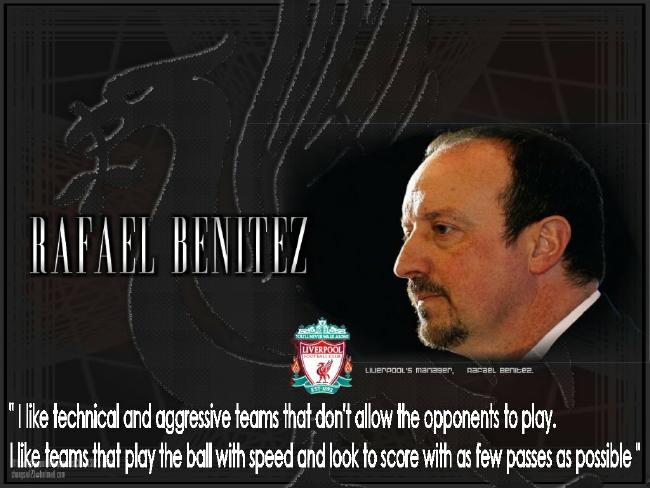
Benitez likes fast, direct counter-attacking and abandoned Robbie Keane after only a few months, on realising that the Irishman wanted more touches than that style allows. Benitez had intended using Gerrard deeper but returned him to the role of Torres’ support in which he scored 22 goals in 2007-08. Gerrard already has 21 in 2008-09 even though he was operating earlier in the season as a holding player. “With Gerrard you know he is so good you can play him in different positions. If you need to change him for one specific game, you can do it,” Benitez said. “The team has balance with Gerrard and Torres in their positions and two midfielders.
“We are creating chances and scoring goals, so maybe we don’t need to change too much. For the team it is the best combination. We have to think about the team always.”
Gerrard admits the tough love of Benitez has been needed to make him take this tenet to heart. “Maybe when I was a bit younger I was a bit selfish, thinking of myself a bit too much when Rafa was playing me out of position. I should have maybe taken a deep breath and realised it was for the team,” he said with commendable candour last week.
Gerrard added he was now in his “favourite position” but this seems another trick of Benitez’s management: previously Gerrard appeared to favour being one of two central midfielders, albeit the partner with attacking licence.
Currently, he is a free player at the apex of a midfield three. Sometimes, as when winning a penalty in the 4-1 win at Manchester United, he swaps stations with Torres to become a centre-forward. It is thrilling, flexible, energetic: the stuff of modern football.
Torres has settled so well on Merseyside for the same reason Gerrard is cherished: he is a superstar with a blue-collar outlook. Dalglish and Rush were the same. Rush did not just wait and score but was an indefatigable harrier of defenders, and Mark Hughes, a partner for Wales, likes Torres’ similar appetite for the fray.
“I’ve a lot of respect for what he’s been able to do because I think it’s especially difficult for strikers with big reputations to come to our league and it’s one which is tougher physically than he was used to,” Hughes said.
“Torres played in a league where the skill of drawing fouls is respected, so to speak, and in this league it’s frowned upon. He’s realised that here you have to stand on your feet, you’ve got to ride challenges and as a consequence he’s been excellent.”
Barcelona have their burnished threesome of Lionel Messi, Samuel Eto’o and Thierry Henry. Manchester United rotate attacking options too often for them to have an established forward formation and, while there are attractions in world football’s other top strike pairings – Alexandre Pato and Kaka of AC Milan, Luca Toni and Miroslav Klose of Bayern Munich, Arsenal’s Robin van Persie and Emmanuel Adebayor – none has greater appeal than Gerrard-Torres.
Hiddink hopes Didier Drogba recovers from an ankle injury to reunite with Nicolas Anelka but so far that partnership has looked better on paper than on grass. Benitez is happy to be meeting Chelsea in a Champions League knockout tie without a build-up featuring Jose Mourinho’s bluster and cheek. “I was not distracted before, but you know that some managers want to play too many mind games. With Avram Grant, Luiz Scolari and Hiddink it is managers who have just been doing their job,” Benitez said.
“Mourinho is a very good manager but, okay, we knew it was a difficult situation because we were both fighting to win massive trophies. Maybe it is part of the game, but I think with Hiddink we will just be talking about football.”
You can’t help pining somewhat, however, for the days when Benitez and Mourinho riled each other. Football thrives on combinations and their double act was nearly as good as Torres and Gerrard’s.
Subscribe to:
Posts (Atom)
Popular Posts
-
Link It was early in the morning and Anfield stood empty except for one man. Kenny Dalglish had arrived just after dawn, let himself in, hur...
-
Living the dream, the man who stood up to Mourinho The Times Matt Hughes Once a protégé of the Special One, Porto’s successful coach is now ...
-
Source By Daniel Geey. Daniel works as a solicitor for Field Fisher Waterhouse LLP and advises entities wishing to invest in the football in...
-
The Question: is 3-5-2 dead? In the latest instalment of our in-depth series, Jonathan Wilson tracks the rise and fall of a tactical survivo...
-
link by nicodemus I've have been sick and tired of hearig all this JM bashing and saying" hes a cocky twat" " he'll ...
-
 Introduction Welcome to Euro 2008 and welcome to this column. As you may already know, fortunately, my professional obligations don’t allow...
 -
Rafa Benitez’s Liverpool Machine July 16, 2010 By Joshua Askew A 7th place league finish and a group stage exit in the Champions League ende...
-
This article is composed of extracts from a very long article intitled: From Sacchi to Zeman, Capello and Lippi to arrive at Descartes and K...
-
Source Get stuck in, readers. Photograph: Peter Dazeley/Getty Images The year of the blog? Very possibly, especially with the current batch ...
-
STEVEN GERRARD EXCLUSIVE The trial changed me. It was frightening. I will never celebrate in a bar again - the Liverpool and England star a...