"What do you mean you've hurt 'your' knee, it's Liverpool's knee" - Bill Shankly.

Thursday, February 24, 2011

THE SCOUSER REPORT – RAFA’S UNDERAPPRECIATED LIVERPOOL LEGACY

Source
Rafa Melwood

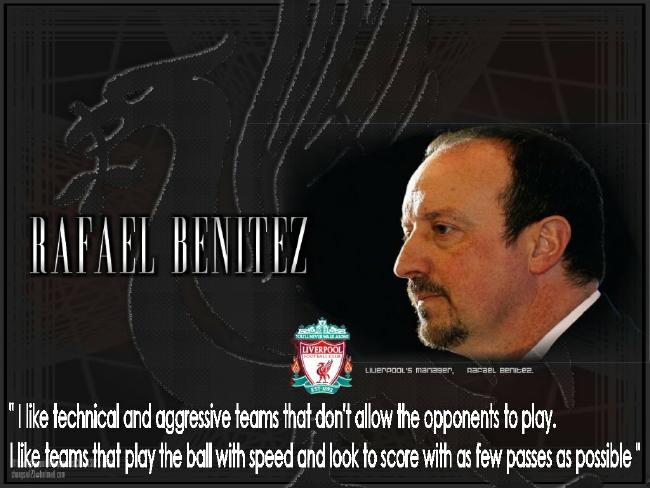
There aren’t many people in football who divide opinion quite like Liverpool’s former boss, Rafa Benitez. Even in his darkest days at Anfield, there was still a fifty-fifty divide. Strong opposition from one quarter was constantly rebutted by staunch defence from the other and, nine months on, the debate has yet to die down.

During his time in charge of the Reds, Benitez was never given much credit by the media. His successes were lucky, whilst his failures, naturally viewed with 20-20 hindsight, could have been easily avoided by all but him. He was routinely persecuted for selecting ninety-nine different line-ups in succession, yet Manchester United’s weekend FA Cup tie against Crawley was Sir Alex Ferguson’s ninety-fifth straight variation since the beginning of the 2009/2010 season.

Of course, you tend to be cut some slack when you are delivering success, as Fergie has done year after year at Old Trafford. Still, if you’re to compare the two contentious rivals fairly, then the status quo when Benitez took the reins at Liverpool should be taken into consideration. Liverpool were light years behind United, as I am sure any rational Red supporter (and there are a few out there not slathering at the bit) will admit.

The problem with making an objective comparison is that a manager is judged on his success, which is very much a subjective term. To a side that has dominated English football for over ten years, a good year is one of continued dominance. In that sense, Fergie has certainly been successful, exactly as Bill Shankly and Bob Paisley were in their days. In the wake of those two legends, however, the reigns of Graeme Souness, Roy Evans and Gerrard Houllier, whilst they may have had their moments, had eroded a formerly great side.

It can be argued that Fergie didn’t inherit a great side when he took over at United. Certainly, it took him a few years to get his program up and running. The Scot, though, had the full backing of the Man United board and was given total control of football operations. Conversely, Rafa had to fight for everything he wanted.

While Benitez' losing toss on Aquilani is often brought up...

Several myths surround Benitez’ time in charge, many completely untrue. The classic Sky Sports-led ‘Rafa spends too much money’ line can be easily shot down. It’s true that he was one of the most active managers in the English transfer market but when one balances the books, it appears that he did better than break-even business.

Over 150 [transfers] between comings and goings in five years does seem a large number. Compared to other clubs? Manchester United, the benchmark in English football, released or sold upwards of 75 players during the same period so it appears normal.

Examining the figures closely actually shows that the net cost of the players bought by Benitez and later sold is virtually non-existent, in fact there is possibly even a small profit when you take into account the small army of free transfers the former Valencia man has acquired. – According to Paul Madden of Goal.com, written on 3 June, 2010.

Full article here.

Other myths are not so easy to quash. There is no club on the planet which makes its backroom activities an open book and it is therefore difficult to say, with precision, exactly who within the club was responsible for what. For instance, Benitez is often blamed for buying Robbie Keane, whom it now seems was forced upon him. Where responsibilities are divided, laying blame becomes a matter of opinion and whilst such conjecture is difficult to dispel, it is too often widely accepted as gospel.

A good example of this is the widespread belief that Rafa destroyed the youth system with his constant import of talent from around the globe. A practise that Arsene Wenger has long been lauded for was suddenly frowned upon when the Spaniard emulated it.

Certainly, there was a clear shortage of players making the transition from Melwood to Anfield during Rafa’s stint in charge. Once Michael Owen and Danny Murphy had been shipped out, only two English players featured in the first team with any regularity, those being Steven Gerrard and Jamie Carragher. Despite the club bringing in hordes of youth players over a six-year period, few made any impact.

The question, however, is whether Rafa was really at fault. Did he destroy Liverpool’s youth setup or was it already in a state of disrepair when he arrived? When players are recruited in their mid-to-low teens, the investment will not come good, if it ever does, for several years. Benitez was only with the club for six years, which suggests that the lack of homegrown talent brought forward during his tenure may have been down to his predecessors. Granted, it’s simple to point the finger at the guy who just left (ask Roy Hodgson) but, in all fairness, look at this year’s squad.

...Rafa is given no credit for the likes of Martin Kelly and Raheem Sterling.

Despite the turmoil, 2010-11 has actually provided some very strong promise. Whilst the club has obviously improved under Kenny Dalglish, he and Hodgson have had one trait in common: both have relied heavily on youth. Whereas Woy was overly protective of the youngsters, King Kenny has trusted them with first team responsibilities, playing them alongside rather than instead of Steven Gerrard, Raul Mereiles and Fernando Torres. Nonetheless, the youngsters on whom Hodgson and Dalglish have relied were supplied by Rafa Benitez.

Martin Kelly has been excellent on almost every occasion he has been given the nod, Lucas Leiva has stepped up massively in the last eighteen months and David Ngog continues to improve. This week’s game in the Czech Republic saw no fewer that four academy members joining up with the first team squad. Raheem Sterling, the latest teen sensation, was rewarded with inclusion following his five-goal haul in the 9-0 youth cup victory against Southend United. Sterling was joined in the squad by John Flanagan, Conor Coady and Jack Robinson.

Admittedly, several first team players were unavailable, but this should not detract from the significance of the quartet being named in the squad. Only one of the four might have made the bench, but just being included in the trip sent a clear message from Dalglish. He is showing faith in youth. I hate to keep using United as an example but Sir Matt Busby said it best; ”If they’re good enough, they’re old enough.”

Perhaps, towards the end, Benitez was guilty of not nurturing the talent he had acquired well enough, failing to see how best to bring them through. It is a fact, though, that he has left Melwood in a much better state than he found it. There is genuine excitement with regard to Anfield’s next crop of youngsters, and rightly so.

“Progress at the Academy in the last year and a half has been absolutely fantastic. That’s great credit to Rafa who brought in Pep Segura, Rodolfo Borrell and Frank McParland. He reorganised the whole Academy and you can see the benefit in the kids now. It’s fantastic to see.” – Kenny Dalglish appreciates the Spaniard’s work at Melwood, even if nobody else does.

Friday, February 18, 2011

The house that built Barca

Source

Pepe Reina, Cesc Fabregas and Carles Puyol are graduates of La Masia

By Matthias Krug

The small, unassuming, brown-brick house built in traditional Catalan style stands almost unnoticed as the great swarm of Barcelona fans head towards the Nou Camp.

This is the house - La Masia - that has been the foundation of Barca's success. It provides the DNA for the club's players, the philosophy for how the game should be played - to pressure, to keep possession, to attack.

The three 2010 Fifa Ballon d'Or finalists Lionel Messi, Andres Iniesta and Xavi Hernandez, and much of Barcelona's first team all learned their trade at La Masia.

Another, of course, is Arsenal captain Cesc Fabregas, who is preparing to face his former classmates in the last 16 of the Champions League on Wednesday.

The stellar names to have graduated from La Masia are impressive and the Spanish champions intend to maintain their conveyor belt of talent at a new state-of-the-art facility just south of the city, which will open in September.

But back to La Masia. It is in these homely surroundings, a mere stone's throw from the Nou Camp, that promising young players have matured into world stars. Graduation photographs of current captain Carles Puyol and coach Pep Guardiola hang on the wall of the brown-tiled dining room where Messi would have had lunch. In the small adjacent games room, Xavi would have played table tennis.

Daily schedule of La Masia student
06:45 Get up and make bed
07:00 Breakfast at La Masia
07:30 School bus pick-up
08:00-14:00 School
14:15 Lunch
15:00 Free hour
16:00-18:00 Added schooling
19:00-20:45 Training
21:00 Shower/Bus back to La Masia
21:30 Dinner
22:00 TV/Internet

Nearby the kitchen, next to the stairs, a cook greets you with a hearty laugh, while in the upstairs study room, which has a view of the Nou Camp, the likes of Iniesta would have done their homework.

The bedrooms are split up with a few on the top floor and the remainder sprinkled around the Nou Camp.

La Masia has an air of tradition mingled with expectancy and an atmosphere of fun and familiarity.

There is not much more to the place than that, but it is these 600 square metres that make the Barcelona youth system so unique in producing the football equivalent of gold.

"This Barcelona team is made up of a lot of people from La Masia, and that's an important factor in our success, because we know each other for such a long time," Iniesta told BBC Sport.

"We grew up here together with the same idea of football in mind and playing according to the same philosophy."

And, in many ways, it is Iniesta, the midfielder lauded by fans across Spain this season for his 2010 World Cup-winning goal, who personifies La Masia's spirit.

"Andres is one of the players who best represents what we stand for here in La Masia, who most comes here to visit us, and who has the best links with us," said La Masia director Carles Folguera as we settled down for an interview in the conference room next to the small wooden bar area that leads into the residence.

Andres Iniesta, Lionel Messi and Xavi
Barca's three Fifa Ballon d'Or finalists

"Andres had a very bad time at the start here in La Masia. He's very family orientated, and with his family far away in Albacete, he took some months to adapt.

"But he did adapt very well in the end, and he's really humble considering all that he's achieved. Here we teach discipline, order, control, and we try to show that a football player can be a star without being a 'show-off', just by making your team-mates better."

The key to Barca's current success is a philosophy of play which emerged as a direct descendant of Holland's Total Football of the 70's, and is implemented throughout the club's teams - from seven-year-olds right up to the first team.

"Everyone says our philosophy started with the 'Dream Team' of Cryuff," Folguera stated.

"I think it was born out of the attempt to dominate play by keeping possession of the ball. We're always looking for a type of player who's not physical but a very good thinker, who's ready to take decisions, who has talent, technique and agility. Physical strength is not important."

Scouted from across Spain, the 60 young players who live at La Masia play surprisingly little football - just over one and a half hours per day.

Instead, there is a heightened emphasis on school work, with players expected to attend extra classes with tutors at La Masia once they return to the centre after a day at school.

This way, the students who do not make it into professional football can opt for university or find employment.

"Here is where the stars all started," added Folguera, throwing a proud glance at photographs of some of the most illustrious years to have graduated from La Masia: one includes Liverpool goalkeeper Pepe Reina with Xavi and Puyol.

"So the current players think: 'I'm in a good place'. But that's also a danger. We have to let them see that the dream is a long journey. We tell them to have patience, and that not all of them will make it.

"Pep Guardiola likes to help, but not all 48 players who are currently here can make it. Despite this, La Masia is of course the ideal place for a young player to come."

La Masia director Carles Folguera surveys a picture of graduated classes in the dining room
Folguera has seen many current stars blossom at La Masia

The less-is- more approach of Barcelona's training regime is designed to make each training session of the highest possible quality.

"It is all about bringing high intensity into those sessions," the club's football youth academy co-ordinator Albert Puig explained.

"Up to the age of 16 we don't do any fitness training with the boys, just practice with the ball. Then we add the fitness training, but always incorporated into exercises with the ball."

Little wonder, then, that players like Pedro, who hails from the Canary Islands, and local players such as Sergio Busquets and Gerard Pique seemingly run with the ball stuck to their boots.

Of course, there have been mistakes - and costly ones at that - with Fabregas allowed to leave for the English Premier League and Arsenal and Pique spending four years under Manchester United manager Sir Alex Ferguson at Old Trafford.

Pique came home at a cost of £9.7m, but Fabregas is still in north London.

Watching the La Masia graduates in the Barcelona first team the game seems easy. They exhibit a sureness bordering on laziness, zip the ball back and forth in triangles and play double-one-two's that leave the opposition - and the crowd - awestruck.

"It doesn't just look easy. It is easy to play with the La Masia players," Brazilian right-back Dani Alves told the BBC. "They have unbelievable qualities on the ball and you have to be happy about playing in a team like this."

And still La Masia keeps churning them out.

Andreu Fontas, Thiago Alcantara, Marc Bartra, Jonathan dos Santos and Victor Vazquez offered a glimpse of the next Barca generation in December 2010 in Barcelona's final Champions League group match against Russian champions Rubin Kazan.

Qualification for the knockout stages of European club football's most prestigious competition was already in the bag but the largely second-string side were comfortable winners, with Fontas and Vazquez scoring in a 2-0 win.

La Masia
It costs £8 million a year to run La Masia

Why do other top clubs around Europe not replicate the La Masia model, which is estimated to cost about a fifth of the £50m fee Chelsea spent on signing Fernando Torres from Liverpool in January?

"Other clubs like Real Madrid have a good youth system too, the difference is just that they don't use theirs," Puig added. "So the work is left unfinished. We on the other hand incorporate our talents into the first team on a regular basis. It's a little bit like producing a Ferrari but then not using it."

It comes with a touch of melancholy, then, that this iconic building on the road leading to the Nou Camp will soon no longer be used to nurture the club's young players.

La Masia is closing down at the end of the 2010-11 season and is to be replaced by new facilities - for 70-80 residents - in the Ciudad Deportiva in Sant Joan Despi.

"It is a necessary move. The new facilities are more modern. These are new times, but we do not want to lose the familiar essence of this building," Folguera reflected.

Barcelona's school of excellence will expand from 600 square metres to 5,000; from two floors to five; from ageing to entirely modern facilities. But memories and a sense of pride will remain in this old brick house which has seen the stars of world football come and go.

Xavi Hernandez is nominated for the Ballon d'Or

Ballon d'Or trio light up World Cup

Thursday, February 17, 2011

LOL

Popular Posts

Labels

188Bet (2) Alberto Aquilani (1) Andre Villas Boas (2) Andy Carroll (1) Aragones (1) Babel (1) Barcelona (1) Barnes (1) blogs (1) Brad Jones (1) Brendan Rodgers (2) Capello (2) Casillas (2) Cristiano Ronaldo (1) Dalglish (5) Dalla Valle (1) Daniel Agger (1) Del Bosque (2) Diego Maradona (2) Eto'o (1) Euro08 (1) Everton (1) Evra (1) Fergie (2) Fernando Torres (5) Fitness (1) Football tactics (46) Freak Goals (1) funny (2) Gaffs (1) Gary Lineker (1) Gerrard (4) Guardiola (3) Harry Redknapp (1) Herrera (1) Highlights (1) Hillsborough (2) Hodgson (3) Howard Webb (1) Jan Molby (2) Javier Mascherano (2) Joe Cole (1) John Aldridge (2) John Barnes (1) Jonjo Shelvey (1) Jordan Henderson (2) Jose Segura (1) Juan Mata (1) Just for a Laugh (1) Kenny Dalglish (7) Kolo Toure (1) Kuyt (3) LeBron James (1) Level 3 (2) Lionel Messi (3) Liverpool FC (1) Lucas (4) Lucas Leiva (2) Luis Enrique (1) Luis Suarez (9) Mancini (1) Martin Skrtel (2) Maxi Rodriguez (1) micha (1) Michael Owen (2) Michels (1) Mourinho (3) Owen (1) Pablo Aimar (1) Patrice Evra (1) Pennant (1) Pepe Reina (1) Philippe Coutinho (2) Pre-season (1) Rafa (46) Ralf Rangnick (1) Ramos (1) Reina (2) Rodolfo Borrell (1) Roy Hodgson (14) rumours (1) Sacchi (2) Sebastian Coates (1) Shankly (1) Skills Challenge (3) Squad size (1) Squad worth (1) Steven Gerrard (2) Stewart Downing (2) Tevez (1) Thierry Henry (1) Thommo (1) Tomkins (12) Torres (3) Transfers (4) TV Competitions (3) UK Academy system (1) Xabi Alonso (2) youngsters (4) Youtube Scout (7) Zonal Marking (2)

Quote of the moment

Defying belief however, is a market Benitez has cornered quite well. The moment you think Benitez is clueless, he defies it by pulling off a result of majesty, like the one achieved in Madrid. The moment he is hailed a genius, he masterminds toothless surrender to a team going nowhere. In the ongoing Anfield power struggle, just when he was cornered by the firing squad, the Spaniard's demise at Liverpool looking practically assured with the ominous suspension of betting by the bookmakers, he squeezes out through a narrow trapdoor and eliminates Rick Parry. Rafa Benitez is Keyzer Soze.
- Just Football blog: The Curious Beast that is Football 28 Feb 2009